

• Gantry Robot Manufacturer & Articulated Arm Integrator

China Best Arm Ball Joint Suppliers?

China’s arm ball joint suppliers serve a market shaped by enormous vehicle production and demanding suspension requirements. OICA reported that global motor vehicle production reached approximately 93.5 million units in 2023, highlighting the scale of the supply chain behind every steering and suspension component. That figure does not measure arm ball joint demand directly, but it shows why buyers need clear evidence of manufacturing capacity, material control, and consistent inspection.

A dependable Arm Ball Joint must do more than fit the control arm. Its stud should move smoothly without excessive play; its boot should stay seated around the joint, even when exposed to road grime and repeated suspension movement. Small details matter. A polished catalog image cannot confirm them. Buyers should compare dimensional drawings, load-test documentation, traceability records, and sample inspection results before choosing a supplier.

This guide examines Chinese suppliers through those practical checks, alongside production experience, communication, customization, and quality-control practices. OICA’s 2023 production report provides useful industry context, but it cannot verify any individual factory’s performance. No named expert quotation was supplied with the source material, so attributing an unverified statement would undermine trust. That is worth acknowledging. Supplier claims still need independent scrutiny, and even a strong sample does not guarantee consistent future batches. The aim here is a grounded shortlist—not a promise that one supplier fits every vehicle program.
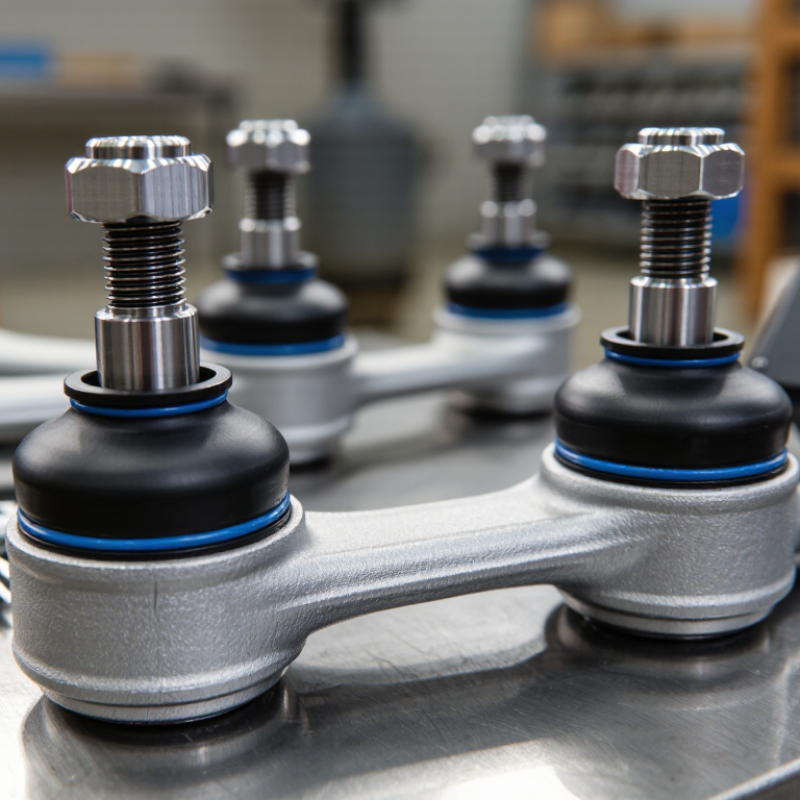
China Best Arm Ball Joint Suppliers?

What Arm Ball Joints Are and Where They Are Used

An arm ball joint is a pivot between a suspension control arm and the steering knuckle. It lets the wheel move up and down while still turning left or right. Inside, a hardened ball stud sits in a close-fitting socket, usually protected by a rubber or polymer boot. Small part. Big job.

Arm ball joints are common in front suspensions, including designs with upper and lower control arms. Some rear multi-link suspensions use similar joints to guide wheel movement. On a rough road, the joint moves as the tire passes over a pothole, helping maintain the wheel’s position under changing loads. Its exact role depends on the suspension layout; not every vehicle uses the same arrangement.

Wear can develop gradually. A torn boot may let in grit and water, while a loose joint can contribute to clunks, uneven tire wear, or vague steering. These signs have other possible causes, so they are not proof by themselves. A visual check can miss early play. Proper inspection should follow the vehicle’s service procedure, with the suspension safely supported. When comparing suppliers, buyers should verify fitment details, material specifications, and inspection records rather than relying on appearance alone.

Key Criteria for Evaluating Arm Ball Joint Suppliers in China

Choosing an arm ball joint supplier in China requires evidence beyond a low quotation. Ask for drawings, tolerance records, and material specifications for the housing, stud, and bearing liner. Small dimensional errors can affect steering response and accelerate uneven tire wear. Check whether production samples match approved drawings, then inspect thread fit, stud articulation, and boot seating. Feel for smooth movement. A gritty spot matters.

Ask how heat treatment and forging parameters are monitored, and whether batch records can trace each lot to inspection results. Useful quality data includes hardness, pull-out strength, articulation torque, and fatigue-test outcomes, with test conditions clearly stated.

Confirm the supplier can explain its sampling plan and corrective-action process when a measurement falls outside limits. Visit or request a production audit if order volume justifies it. Photos help, but they are not proof.

Review packaging, too: a torn dust boot or loose parts in a carton can undo good manufacturing.

No checklist catches everything. A supplier may pass one audit and still drift later, so maintain incoming checks and periodic requalification. This adds time and cost, a trade-off worth discussing honestly.

Types of Chinese Suppliers and Their Manufacturing Capabilities

China Best Arm Ball Joint Suppliers?

Chinese suppliers generally fall into three groups. Integrated manufacturers handle forging, machining, assembly, and inspection in one facility. This can simplify process control. Specialist factories may focus on ball studs, sockets, dust boots, or heat treatment, then coordinate with other producers. Trading companies can combine products from several factories, but buyers should confirm who actually makes each component.

Manufacturing capability matters more than a broad catalogue. Ask how the supplier controls steel grades, forging temperature, machining tolerances, and heat-treatment records. For assembled joints, check boot fit, grease retention, articulation torque, and pull-out strength. Request dimensional reports and fatigue-test data tied to the sample or production batch. A polished sample can still hide weak process control. Paperwork is not proof by itself; compare records with factory equipment and inspection routines. Even a good audit has limits.

Tips: Request a process flow, material certificates, and recent test results. Confirm whether testing is in-house or outsourced. Inspect a production sample, including the boot, stud finish, and socket movement. Leave time for repeat testing; I would not assume the first sample represents every batch.

China Arm Ball Joint Supplier Types and Typical Capabilities

This qualitative map compares capabilities commonly found in different supplier models—not audited company data. “Often in-house” indicates a capability commonly performed internally; other operations may be outsourced. Actual capabilities vary by supplier and product.

How to Verify Supplier Quality, Compliance, and Production Capacity

Selecting a China-based arm ball joint supplier takes more than reviewing a sample and a certificate. OICA reported 93.5 million motor vehicles produced worldwide in 2023, showing the scale and consistency demanded across automotive supply chains. That figure does not prove any supplier’s capacity. Ask for monthly output by production line, current utilization, lead times, and documented backup plans. Then compare the figures with your forecast and order history. A large factory can still miss delivery dates.

Verify that the IATF 16949 certificate covers the actual manufacturing site and relevant processes, then confirm its validity with the issuing body. Request recent dimensional inspection records, material certificates, heat-treatment results, and batch traceability for the ball stud and housing. Review the control plan and process capability data for critical dimensions; investigate unstable trends, not just average results. The ISO Survey 2023 lists 1,082,049 valid ISO 9001 certificates worldwide, but certification counts do not guarantee product quality. Paperwork alone can mislead. During an audit, follow one component from incoming steel to final inspection, and check whether records match the parts on the floor. No checklist catches every weakness; a rushed audit can miss one.

China Best Arm Ball Joint Suppliers? - How to Verify Supplier Quality, Compliance, and Production Capacity
Evaluation Dimension Weight Evidence to Request How to Verify Suggested Acceptance Guideline Score (0–5)
Quality Management and Product Validation
Quality management system 15% Current quality-management-system certificate, scope, issuing body, audit history, and corrective-action records. Confirm certificate validity and scope with the issuing certification body; check that the covered site and activities match the quoted production. Certificate is current and covers the manufacturing site and relevant processes. Automotive programs may require an automotive quality system, depending on customer requirements. Not assessed
Process control and capability 15% Process flow, control plan, inspection records, measurement-system studies, and capability data for agreed critical characteristics. Review records from recent production lots; compare measurement methods, sample size, and control limits with the drawing and control plan. Critical characteristics are identified, measured with suitable equipment, and controlled to customer-approved limits. Set capability thresholds in the purchase specification. Not assessed
Product testing and validation 15% Dimensional reports, material test reports, load or fatigue results, articulation or torque results, corrosion results, and approved sample records. Match test samples and methods to the applicable drawing, test specification, and production configuration; confirm laboratory competence where required. All required tests pass the buyer-approved specification. Test conditions and acceptance limits should be agreed before quotation or approval. Not assessed
Material and lot traceability 10% Material certificates, supplier-lot records, heat-treatment records where applicable, and finished-part identification or batch records. Select a finished-part lot and trace it backward to its material and process records; verify that records can be retrieved within the agreed response time. Traceability links finished parts to defined production and material lots and is retained for the period required by the customer or applicable regulations. Not assessed
Compliance, Capacity, and Supply Reliability
Regulatory and customer compliance 10% Applicable declarations, restricted-substance data, product specifications, and customer-specific compliance documents. Confirm requirements for the destination market and end use; check declarations against the product, material, and applicable legal or customer requirements. Required documents are current, product-specific, and consistent with the applicable market and customer specification. Requirements vary by application and destination. Not assessed
Production capacity and available capacity 15% Rated output by process, working shifts, bottleneck equipment, recent utilization, planned maintenance, and capacity-allocation data. Reconcile stated output with cycle times, shift calendars, yield assumptions, and bottleneck operations; review recent production records or conduct an audit. Verified available capacity meets the buyer’s forecast and peak demand. A planning buffer, such as 20% above forecast, may be used if agreed by both parties. Not assessed
Delivery performance and continuity 10% Recent on-time-delivery records, lead-time breakdown, inventory policy, business-continuity plan, and backup arrangements for critical processes. Review delivery performance over an agreed period and compare promised lead times with actual order history and production constraints. Performance meets the buyer’s agreed delivery target, with documented escalation and continuity plans for disruptions. Not assessed
Change control and corrective action 10% Procedures for engineering or process changes, nonconformance handling, root-cause analysis, and corrective-action closure. Review completed examples and confirm that changes require notification and approval when specified by the customer. Changes are documented and communicated before implementation when approval is required; corrective actions include evidence of effectiveness. Not assessed
Total weighted score 100% Score each dimension from 0 (no evidence) to 5 (verified and fully meets requirements). Weighted result = sum of (score ÷ 5 × dimension weight). Pending verification

How to Compare Pricing, Lead Times, and After-Sales Support

China Best Arm Ball Joint Suppliers?

How to Compare Pricing, Lead Times, and After-Sales Support

When comparing arm ball joint suppliers in China, do not judge a quotation by unit price alone. Check what it includes: material grade, machining, heat treatment, inspection, packaging, and minimum order quantity. A low figure may exclude tooling or export packing. Ask for a line-by-line quote. Small details matter.

Lead times need the same scrutiny. Request separate estimates for samples, approval, production, final inspection, and dispatch. Then ask what could move each date, such as a drawing change or a delayed component. Dates matter. Suppliers should explain capacity in practical terms, not just promise speed. A sample that arrives quickly is useful only if its dimensions and articulation match your requirements. Record approval criteria in writing; memory is unreliable.

After-sales support is easier to compare before an order than after a failure. Confirm warranty scope, response time, batch traceability, and the process for investigating a returned joint. Ask whether inspection records can be linked to lot codes, and what evidence is needed for a claim. A clear answer is more useful than a broad assurance. Even a careful checklist can miss a detail, so review one real complaint scenario together. It may feel cautious, but that conversation often reveals how the supplier handles responsibility.

Article Source: