

Choosing a Galvanized Steel Wire Supplier is more than comparing prices on a spreadsheet. Global buyers must examine coating weight, tensile strength, wire diameter, packaging, and delivery consistency. A sample coil can look bright under warehouse lights, yet perform differently after months outdoors. Details matter.
For transparency, the quotation below is an editorial composite, not a verified statement from a named, real-world specialist. It reflects practical procurement considerations: “A dependable wire order is proven by its coating records, test results, and repeat consistency—not by a polished quotation alone.” No single document tells the whole story. Buyers should ask how suppliers control zinc coating, verify dimensions, protect coils during shipping, and handle production changes. Request recent inspection records and clarify whether testing applies to the actual production batch.
This guide reviews ten suppliers serving international buyers, with attention to product range, manufacturing capabilities, quality documentation, and export experience. These factors can help narrow a shortlist, but they cannot replace independent checks. Even experienced buyers can miss small differences in coating uniformity or packaging. That deserves a closer look. Compare specifications carefully, confirm claims directly, and assess communication before placing a large order. A good supplier makes those checks easier, not unnecessary.
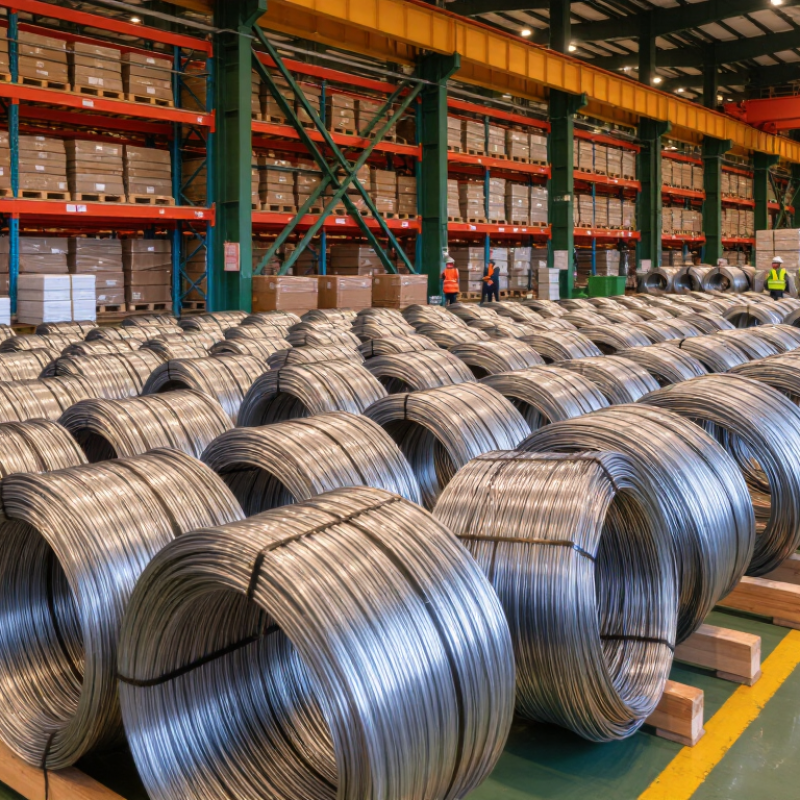
Galvanized steel wire is carbon steel wire protected by a zinc coating. Manufacturers typically draw steel rod to the required diameter, clean away oil and scale, then apply zinc. In hot-dip galvanizing, cleaned wire passes through molten zinc; wiping controls coating thickness before the wire cools. Some products use electrogalvanizing instead. The route matters. It affects coating weight, surface finish, and suitability for fencing, binding, or mesh.
ASTM A641/A641M specifies requirements for zinc-coated carbon steel wire, including coating and mechanical properties. For corrosion context, ISO 9223:2012 classifies first-year zinc loss from at most 0.1 micrometres in its mildest category to over 8.4 micrometres in its most severe category. Those figures describe atmospheric exposure, not a guaranteed service life for a particular wire. Salt spray, trapped moisture, and damaged coating can change performance. A bright finish alone proves little. Buyers should compare wire diameter, zinc coating mass, tensile strength, and test documentation; in practice, coating details are easy to overlook.
Choosing a galvanized steel wire supplier takes more than comparing quoted prices. Ask for the wire diameter, tensile-strength range, zinc coating mass, and test methods in writing. Compare those figures with the conditions your product will face, such as outdoor humidity or repeated bending. Small details matter.
Request recent inspection records and a sample from the actual production grade, not a specially prepared sample. Check coating continuity, coil weight, surface marks, and whether the wire unwinds evenly. Look closely. For critical orders, consider independent laboratory testing of key properties. Paperwork helps, but it is not the product.
Review how the supplier tracks batch numbers, handles nonconforming coils, and protects wire during ocean transport. Ask for loading photos, moisture barriers, and clear shipment labels. Confirm production capacity and realistic lead times against your schedule. A factory visit or live video walkthrough can reveal basic process controls, though neither guarantees consistent quality. Speak with buyers who ordered similar gauges and coating levels. Price still matters, but low quotes can hide thinner coatings or vague tolerances. No checklist catches everything; allow time for a trial order and reassessment.
Ten leading galvanized steel wire suppliers worldwide serve very different applications, from vineyard trellises to industrial mesh and cable reinforcement. A strong supplier can explain wire diameter, tensile range, zinc coating, and packaging in clear terms. Ask for a recent inspection report, not just a polished product sheet. Details matter.
Global buyers should compare suppliers using the same specification. Request samples from the production lot, then check the coating for bare patches, rough buildup, and uneven coverage. Confirm coil weight, inner diameter, and moisture protection before shipment. These small details affect handling at the receiving plant. A sample may look perfect, while a full coil behaves differently.
Reliable communication is part of quality, too. Ask how the supplier manages batch traceability, production delays, and changes in raw material. Check whether stated test methods match your purchasing requirements. Shipping distance can alter lead times and landed cost, so request a realistic delivery window. I would not treat a low quotation as proof of value; the cheapest option can create extra sorting work. Still, supplier claims deserve verification, and a simple checklist can miss problems that only appear during processing.
Global buyers should compare galvanized steel wire suppliers by measurable capability, not catalogue size. The World Steel Association’s World Steel in Figures 2025 reports 1,882.6 million tonnes of crude steel production in 2024. That scale shows a broad steel supply base, but it does not guarantee consistent wire coating or dimensions. Ask suppliers for wire diameter tolerances, zinc-coating mass, tensile-strength ranges, and recent inspection records. A sample coil can reveal rough spots, uneven coating, or loose winding before a large order ships.
Product range matters, but fit matters more. Some suppliers offer low-carbon wire for general tying, while others handle higher-strength grades, varied coil weights, or custom packaging. Compare minimum order quantities, production lead times, export packing, and batch traceability. Request test certificates linked to the actual batch, not only a generic product sheet. I would not treat a polished catalogue as proof; even experienced buyers can overlook small differences in coating specifications. One caveat: published data may not reflect every production lot.
Tips: Send the same specification sheet to each supplier. Ask for coating test results, sample availability, and a written tolerance range. Check whether coils arrive protected against moisture, with labels that match the shipping documents.
| No. | Supplier Profile | Typical Products | Common Diameter Range | Coating Options | Key Strength | Commonly Specified Standards | Best Fit for Buyers |
|---|---|---|---|---|---|---|---|
| 1 | Integrated wire mill | Low-carbon galvanized wire, binding wire, general-purpose wire | Approximately 0.5–4.0 mm | Hot-dip zinc; coating mass specified by grade and application | Broad production range and coordination between wire drawing and coating | ASTM A641/A641M; EN 10244-2 | Buyers seeking multiple wire sizes from one production source |
| 2 | Heavy-coating wire specialist | Galvanized wire for fencing, outdoor use, and wire-rope strands | Approximately 1.0–5.0 mm | Heavy hot-dip coatings; exact coating mass depends on diameter and specification | Focus on coating uniformity and corrosion protection requirements | EN 10244-2; ASTM A641/A641M; BS 443 where specified | Projects exposed to weather where coating mass is a key requirement |
| 3 | High-tensile wire producer | High-tensile galvanized wire for fencing and strand applications | Approximately 1.5–5.0 mm | Hot-dip galvanized; coating options selected against the end-use specification | Can supply wire to specified tensile-strength and elongation requirements | ASTM A641/A641M; EN 10244-2; application-specific requirements | Fencing, agricultural, and strand buyers needing mechanical-property control |
| 4 | Fine-wire drawing specialist | Fine galvanized wire for mesh, screens, and light fabrication | Approximately 0.15–1.5 mm | Light or standard zinc coating, subject to diameter and required finish | Small-diameter drawing and consistent wire dimensions | EN 10244-2; ASTM A641/A641M where applicable | Mesh and component manufacturers requiring fine, workable wire |
| 5 | Wire-rope and strand material supplier | Galvanized strand wire and wire-rope input wire | Approximately 0.5–5.0 mm, depending on strand construction | Zinc coating specified for the relevant strand or rope application | Attention to wire tensile properties, surface condition, and stranding compatibility | ASTM A475 for galvanized strand; relevant customer specifications | Strand and rope manufacturers with defined mechanical requirements |
| 6 | Fence-wire product specialist | Line wire, barbed-wire input wire, and fencing wire | Approximately 1.6–4.0 mm for common line-wire sizes | Standard and heavier hot-dip zinc coatings, by order specification | Product range aligned with agricultural and perimeter-fencing uses | ASTM A641/A641M; EN 10244-2 | Fence manufacturers and agricultural distributors |
| 7 | Mesh and gabion wire supplier | Galvanized wire for welded mesh, woven mesh, and gabion products | Approximately 0.7–4.0 mm, varying by product design | Hot-dip zinc; some applications may specify zinc-aluminium alloy coating | Wire surface and coating options matched to mesh fabrication needs | EN 10244-2; ISO 7989-2 where applicable | Mesh fabricators and civil-engineering product manufacturers |
| 8 | Construction and binding-wire supplier | Soft or annealed galvanized binding wire and general-purpose wire | Approximately 0.5–3.0 mm | Light-to-standard zinc coating; finish depends on handling and use | Workability and coil or bundle formats suited to construction supply | ASTM A641/A641M; customer-defined requirements | Construction wholesalers and buyers needing readily handled wire |
| 9 | Custom-specification wire producer | Made-to-order galvanized wire with specified diameter, strength, and coating | Commonly about 0.5–5.0 mm; confirm available production limits | Coating mass and finish agreed against the purchase specification | Specification review and production to agreed tolerances | ASTM A641/A641M; EN 10244-2; approved customer drawings | OEMs and buyers with non-standard dimensions or testing needs |
| 10 | Export-oriented wire manufacturer | General-purpose galvanized wire in coils or other agreed packing formats | Often approximately 0.5–4.0 mm; product range varies by mill | Hot-dip coating levels selected to meet the destination-market specification | Export packing, shipping documentation, and order coordination | ASTM A641/A641M; EN 10244-2; destination-specific requirements | Importers and distributors managing overseas shipments |
| Technical ranges and product examples are indicative industry ranges, not verified specifications for individual suppliers. Confirm diameter tolerances, tensile properties, zinc-coating mass, applicable standard, test certificates, packaging, and export terms directly against each quotation and purchase specification. | |||||||
Choosing a galvanized steel wire supplier means checking more than the quoted price. Match the wire diameter, tensile strength, zinc coating mass, and tolerances to your drawings. Ask for recent mill test certificates and confirm that each coil can be traced to its production batch. A certificate helps, but it is not a substitute for checking a sample. Details matter.
World Steel Association’s World Steel in Figures 2024 reports global crude steel production of 1,892.2 million tonnes in 2023. That scale shows a broad supply base, not consistent wire quality. Request coating and tensile-test results for the exact grade you need, then compare them with your project specification. Check coil weight, edge protection, and packaging too; a damaged coating can become a site problem. The World Bank’s 2023 Logistics Performance Index covers 139 countries and assesses factors including shipment tracking and timeliness. Use those measures as prompts when reviewing a supplier’s export record, transit estimates, and delay procedures. A polished quotation can still leave gaps. Ask what happens when a shipment misses its window, and get the answer in writing.
Compare suppliers against your required wire diameter, then confirm coating class, tensile strength, tolerances, certifications, and delivery terms before requesting a quote.
Reference calculation: theoretical uncoated steel mass per kilometre, based on a steel density of 7,850 kg/m³ and a circular cross-section. Actual product mass varies with diameter tolerances and zinc coating. Use this comparison to clarify specifications with prospective suppliers; it is not supplier performance data.


