

Industrial filtration decisions often begin with a practical problem: a clogged line, unstable pressure, or particles reaching sensitive equipment. A Stainless Steel Filter Element can offer strength, cleanability, and resistance to demanding process conditions. But the material alone does not guarantee reliable filtration. Pore size, alloy grade, seal compatibility, and cleaning method all matter.
The U.S. Department of Energy’s *Improving Compressed Air System Performance* sourcebook reports that compressed-air systems can consume about 10% of electricity used in industrial facilities, and more in some plants. That makes pressure loss across a filter worth examining, not merely its purchase price. In hydraulic applications, ISO 16889 defines a multipass test method for evaluating filter performance. Its results can help compare elements under controlled conditions, though actual service conditions still matter. Laboratory figures are not the whole story.
This guide compares seven common stainless steel filter element designs, including mesh, pleated, and sintered options. It considers filtration rating, flow capacity, pressure drop, corrosion resistance, and maintenance needs. A 316L element may suit some corrosive services, while another process may call for a different alloy or construction. Details matter. No element is universally best. Even a well-specified filter can disappoint when the fluid, operating temperature, or cleaning cycle was misunderstood. The comparisons below are intended to support informed selection, not replace a review of process data and supplier documentation.
7 Best Stainless Steel Filter Elements for Industrial Use?
How Stainless Steel Filter Elements Work
A stainless steel filter element separates unwanted particles from a flowing liquid or gas. Fluid passes through openings in a woven mesh or pores in a sintered structure. Particles larger than those openings are retained, while cleaner fluid continues downstream. Some elements capture debris mainly at the surface; others trap particles within their depth. The design affects flow, filtration rating, and cleaning needs. In operation, pressure difference pushes fluid through the element. As particles collect, pressure drop can rise and flow may fall. It is a useful signal, but not a complete diagnosis.
Tips: Check the specified filtration rating, operating temperature, and chemical compatibility before selecting an element. Track pressure drop during service. Follow the element maker’s cleaning guidance, since aggressive brushing can damage fine mesh.
A stainless steel element can often be cleaned and reused, but reuse is not automatic proof of good performance. Inspect for dents, cracked joints, corrosion, or uneven deposits. A small defect can let particles pass. Also, a filter cannot compensate for poor system design or sudden changes in process conditions. The simple diagram looks tidy; real systems are less so. Confirm performance under actual flow and operating conditions.
Selecting an industrial stainless steel filter element starts with the process fluid, not the micron rating. Check the target particle size, flow rate, operating temperature, and maximum differential pressure. A nominal 10-micron rating is not the same as an absolute rating; ask for the test method and particle-retention data. ISO 16889 defines a multipass test for hydraulic filter performance, including particle-count-based efficiency. That distinction matters. A shiny element can still be unsuitable.
Material compatibility needs equal attention. Stainless steel grades differ in resistance to chlorides, acids, and cleaning chemicals, so review the full fluid composition and cleaning cycle. For viscous liquids, a tightly woven element may create excessive pressure loss; for hot service, verify the rated temperature and seal compatibility. The U.S. Department of Energy’s Improving Compressed Air System Performance sourcebook reports that compressed air can account for about 10% of industrial electricity use, and sometimes more. In those systems, pressure drop deserves close scrutiny.
Ask suppliers for clean and terminal pressure-drop curves, collapse-pressure limits, and documented cleaning-cycle data. Compare them at the actual flow and viscosity, not just catalog conditions. A washable element may lower replacement waste, but repeated cleaning can alter pore structure. Measure after cleaning. One practical detail is often missed: leave room to remove the element without disturbing nearby pipework.
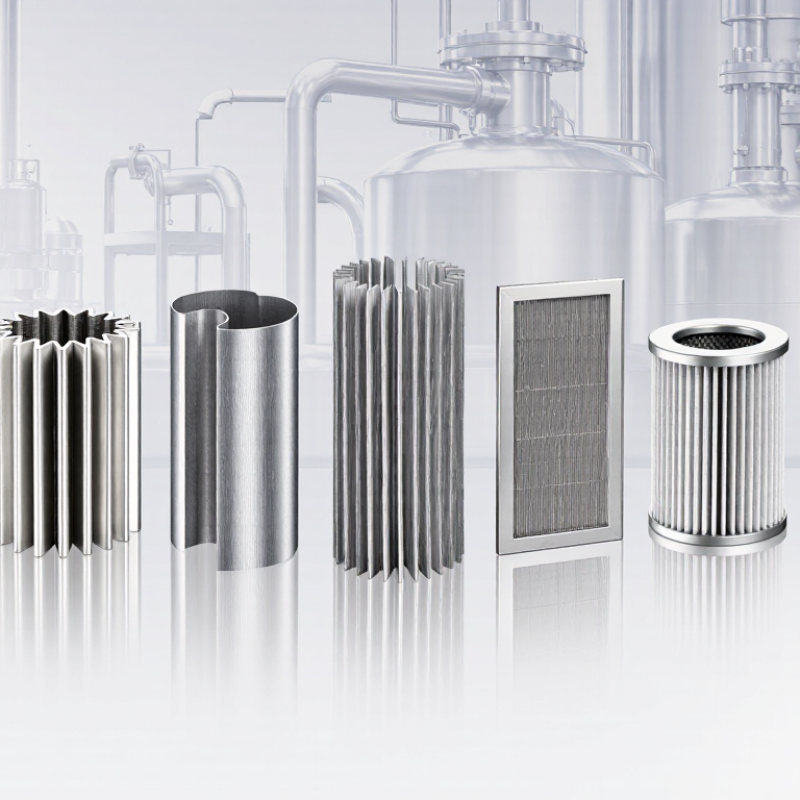
Industrial filtration depends on more than pore size. Flow rate, temperature, cleaning method, and particle shape all matter. Seven stainless steel filter element designs meet different needs: pleated cartridges increase available surface area; woven mesh screens catch particles at the surface; sintered powder elements provide depth filtration; wedge-wire screens pass liquid through narrow slots; perforated-core elements offer support; wire-wound designs create controlled openings; and multilayer laminates combine layers for filtration and strength. They are not interchangeable.
Check the fluid chemistry before choosing an alloy, and confirm the element’s operating pressure and temperature. Mesh can be easy to inspect, but fine openings may clog quickly in a dirty stream. Sintered elements can retain particles within their structure, which may complicate cleaning. A practical selection can still be imperfect; pilot testing often reveals behavior that a specification sheet misses.
Tips: Compare filtration efficiency, flow, and cleaning requirements under real operating conditions. Ask how the element will be inspected after repeated cleaning. Small details matter.
| Filter Element Design | Typical Construction | Common Filtration Range | Strengths | Typical Industrial Uses | Cleaning and Service Notes |
|---|---|---|---|---|---|
| Pleated woven-wire mesh | Woven stainless steel cloth pleated around a perforated support core; commonly made from 304 or 316L stainless steel. | Approximately 5–200 μm, depending on mesh and rating method. | High surface area in a compact element; supports relatively high flow and is suitable for many liquid filtration duties. | Hydraulic and lubricating oils, process liquids, and pre-filtration in industrial systems. | Often cleaned by backwashing, rinsing, or ultrasonic methods when the contaminant is removable. Check for pleat damage before reuse. |
| Sintered multi-layer wire mesh | Several woven mesh layers bonded by sintering, usually with a coarser protective layer and a finer filtration layer. | Commonly about 1–200 μm; available ratings depend on layer arrangement and whether the rating is nominal or absolute. | Rigid, supported structure with controlled pore distribution and good resistance to pressure changes. | Polymer processing, chemical service, gas filtration, and applications requiring a reusable porous element. | May be backwashed or chemically cleaned if compatible with the process fluid and contaminant. Cleaning effectiveness depends on particle type and pore structure. |
| Sintered stainless steel powder | Porous element formed by sintering stainless steel powder into a rigid, interconnected pore structure. | Typically around 0.5–100 μm, depending on the powder and manufacturing specification. | Uniform porous body, good mechanical integrity, and options for fine filtration and gas-liquid service. | Gas filtration, chemical processing, fluidized-bed systems, and high-temperature process filtration. | Can often be cleaned by backflushing or suitable chemical methods. Fine pores may be difficult to restore if particles are embedded. |
| Wedge-wire screen | Profile wires attached to support rods, creating continuous slots that widen toward the inside or outside of the element. | Common slot openings are approximately 25–2,000 μm. | Open area helps reduce blinding; the slot geometry supports surface filtration and can facilitate cleaning. | Water intake, wastewater treatment, mineral processing, and separation of larger solids from liquids. | Can be flushed or mechanically cleaned in many installations. Select slot width and flow direction to suit the solids and process. |
| Perforated stainless steel element | Perforated sheet or tube, sometimes combined with a fine mesh layer or used as a support or coarse screen. | Perforations commonly range from about 0.5 mm to several millimetres; finer separation requires an added mesh or other media. | Robust and resistant to handling damage; suitable for coarse particle removal and protective screening. | Equipment inlet protection, pump protection, water systems, and coarse process-fluid screening. | Usually straightforward to rinse or mechanically clear. The open-hole size is not equivalent to a fine micron-rated filter. |
| Sintered woven-wire mesh laminate | Multiple woven mesh layers sintered together, often with a coarse backing layer to support finer layers. | Commonly offered from a few micrometres to several hundred micrometres, according to the laminate specification. | Combines a defined mesh surface with structural support; can provide stable filtration under changing operating conditions. | Process-fluid filtration, polymer lines, and applications needing a durable, reusable mesh element. | Cleaning method should match the contaminant and alloy. Inspect the laminate for corrosion, deformation, or separation after service. |
| Cylindrical screen element | Single-layer woven wire cloth or a supported mesh cylinder fitted to a compatible filter housing. | Commonly about 20–1,000 μm, with finer or coarser options depending on mesh construction. | Simple construction, broad availability of mesh openings, and a practical option for coarse-to-medium filtration. | Water and process-liquid strainers, recirculation loops, and general-purpose industrial screening. | Can be rinsed, brushed, or backwashed where the housing permits. Confirm that the mesh and seams remain intact before reuse. |
Selection note: Filtration ranges shown are typical examples, not universal performance guarantees. Actual particle retention, operating pressure, temperature, corrosion resistance, and cleanability depend on the element specification, stainless steel grade, process fluid, seals, and housing. Confirm the required rating and operating conditions with the equipment design requirements.
Matching a stainless steel filter element to an industrial process starts with the contaminant, not the catalogue. Woven mesh suits applications where particles are relatively coarse and openings must be clearly defined. Sintered powder and metal-fiber elements can capture finer particles, but their pressure drop and cleaning needs differ. Pleated mesh adds surface area when space is limited. Multilayer mesh, wedge-wire, and perforated-support designs serve more specialized duties.
Check the fluid’s temperature, viscosity, chemistry, and flow rate. Then compare the required particle retention with the element’s operating pressure and cleaning method. A viscous liquid, for example, may clog a fine element quickly, even when its nominal rating looks ideal. Ask whether the process uses backwashing, manual cleaning, or replacement. Details matter.
Test the selection under realistic conditions. Record the pressure difference across a clean element, then track how quickly it rises during operation. That pattern can reveal whether the rating is too fine or the contaminant load was underestimated. No chart captures every process. Even a careful selection may need adjustment after startup, especially when feed conditions vary.
Correct installation protects both filtration performance and equipment. Check that the element’s material, micron rating, and seal type match the process conditions. Inspect the housing for debris, damaged threads, or a worn gasket. Seat the element evenly; a pinched seal can let unfiltered fluid bypass it. Tighten connections to the specified torque, not by feel alone. Start the system gradually and check for leaks and unusual pressure changes.
Tips: Record the initial differential pressure. Keep a clean spare seal nearby. Never force an element into its housing.
Cleaning needs to suit the trapped material and the element’s construction. Use the documented cleaning method, and avoid abrasive brushes that can damage fine pores. Rinse thoroughly, then inspect for deformation, cracks, or persistent deposits. A clean appearance does not prove that filtration performance has returned. That is easy to overlook. Track pressure drop and cleaning history, and replace the element if performance remains poor or damage is visible. Service life varies with contaminant load, fluid chemistry, temperature, and operating cycles, so fixed replacement intervals may not fit every line. Recheck the schedule against actual operating data.


