

Choosing among the best Storage Rack Upright manufacturers in China takes more than comparing prices or polished product photos. Uprights carry beam loads, resist impact, and help keep warehouse bays stable. Small details matter: column profile, steel thickness, hole spacing, weld consistency, and the fit between upright frames and beams. A sample frame on the factory floor can reveal more than a catalogue image.
As a guiding principle, storage-rack engineer Li Wei puts it this way: “A rack is only as dependable as the upright, its connections, and the checks behind its stated capacity.” Buyers should ask manufacturers for load-test documentation, material specifications, production quality controls, and clear guidance on installation and inspection. Look closely at coating coverage around punched holes and welded joints. Ask how the supplier handles custom dimensions, replacement parts, and changes in order volume. Details count.
No single factory suits every project. A high-bay distribution center may need different tolerances and engineering support than a small parts warehouse. This guide compares manufacturers through product range, technical capability, quality assurance, customization, communication, and after-sales service. It also encourages readers to verify claims directly, review drawings, and assess sample components before placing large orders. Some public information may be incomplete; that deserves scrutiny, not guesswork. The aim is a practical shortlist, grounded in evidence rather than sales language.
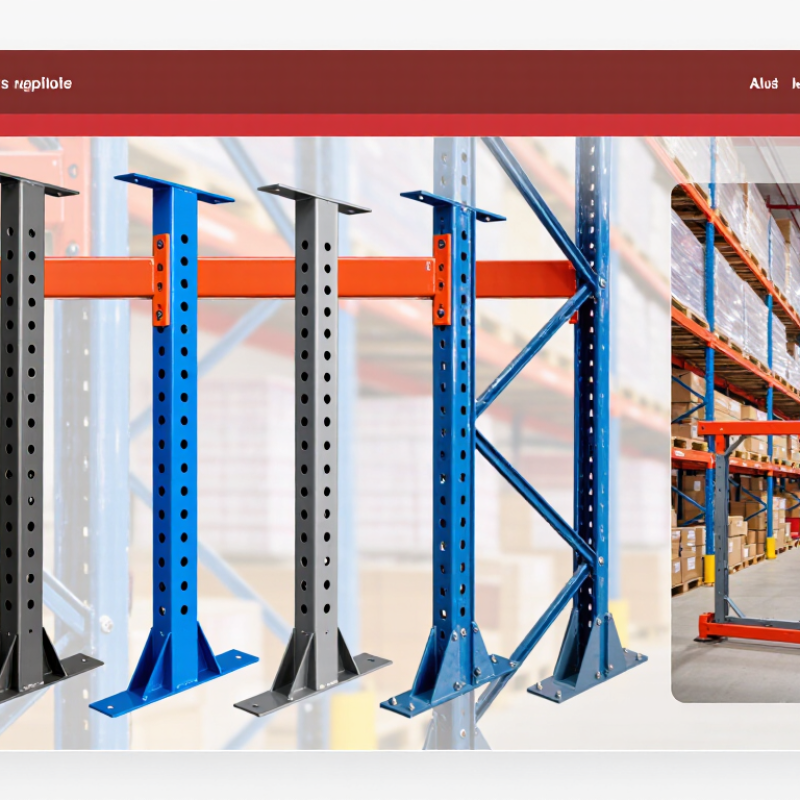
A storage rack upright is the vertical column in a pallet-rack frame. Paired uprights connect with horizontal and diagonal braces to form a stable frame. Perforated slots along each column let warehouse teams position beams at different heights. The beam supports the pallet; the upright transfers that load toward the floor through its base plate. Simple in appearance, but not simple in duty.
Upright capacity depends on steel thickness, column shape, frame height, bracing, and load placement. The Rack Manufacturers Institute’s ANSI MH16.1 specification provides engineering guidance for industrial steel storage racks. In practice, the rack must also match the actual pallet dimensions and operating conditions. A small dent near a column’s base can be easy to overlook. It still deserves attention. The Material Handling Industry’s 2024 Annual Industry Report found that 55% of surveyed companies planned to increase supply-chain technology investment over five years. As warehouses add automation, accurate rack dimensions and clear load ratings matter even more. Technology cannot correct a poorly matched frame. That part is sometimes forgotten.
Storage rack uprights in China are commonly made from cold-formed steel. Production begins with steel coils or sheets selected for thickness and strength. The material is fed through rollers that shape it into a vertical profile. Punching stations create slots for beam connectors and accessories. Small details matter. Slot spacing must stay consistent, or beams may not seat evenly.
After forming, uprights are cut to specified lengths, and base plates or stiffeners may be welded in place. Then comes surface treatment. Depending on the design, parts may be cleaned and powder-coated, or galvanized for added corrosion resistance. Coating quality affects more than appearance; uneven coverage can leave vulnerable edges. Still, a clean finish alone does not prove a part is dependable.
Quality checks can include measuring profile dimensions, inspecting welds, checking coating coverage, and assembling sample components. Some producers also test representative frames under controlled loads. Ask how measurements are recorded and whether checks happen during production, not only at the end. A weakness in the process is easy to overlook: rushed adjustments can create variation between batches. Clear inspection records help buyers compare specifications with actual products.
Compare storage rack uprights against the design standard, not just the quoted steel thickness. ANSI MH16.1 covers the design, testing, and use of industrial steel storage racks; EN 15512 addresses adjustable pallet racking. Ask manufacturers which standard their calculations follow and request load tables for your beam spans and rack heights. A test certificate alone is not a complete design check.
Inspect upright profile, steel grade, frame bracing, welds, base plates, and connector fit. Check that the proposed load capacity matches actual pallet weights and floor conditions. OSHA’s 29 CFR 1910.176(b) requires stored materials to remain stable and secure against sliding or collapse. MHI’s 2024 Annual Industry Report says 55% of surveyed supply-chain leaders planned to invest over $1 million in supply-chain technology within two years, a reminder to check whether rack layouts can adapt to changing operations. Small details matter. Ask for drawings, tolerance records, and coating specifications, then compare them across suppliers. A polished sample can hide inconsistent production. I would also question any quote that gives one capacity figure for every configuration; that shortcut feels convenient, but it deserves a closer look.
Notable storage rack upright manufacturers in China are often distinguished by process control, rather than catalog size alone. Many use roll-forming lines to shape steel sections, then punch connection holes at set intervals. Consistent hole spacing helps beams fit securely and makes later adjustments easier. Details matter. Ask how steel thickness is measured and whether samples are checked against the approved drawing.
A capable manufacturer should be able to explain material grades, load-test methods, coating options, and production tolerances in plain language. Request drawings, inspection records, and photos of finished uprights, including base plates and connector areas. These points are practical to verify. A smooth powder-coated surface looks reassuring, but it does not prove that the steel or welds meet the specification. I would not treat a polished catalog as proof of quality.
For a fair comparison, provide each supplier with the same rack height, beam layout, load requirement, and installation conditions. Check how they handle custom hole patterns and replacement parts, too. Some factories may offer quick sampling but slower documentation; that trade-off deserves attention. A small pilot order can reveal fit issues before a larger purchase, although it cannot replace independent checks of capacity and materials.
A reliable storage rack upright manufacturer should explain how each upright is designed for your specific rack configuration. Ask for the steel grade, measured thickness, section dimensions, hole spacing, and allowable load assumptions. Confirm whether capacity data applies to the complete frame, not just one component. Details matter. A polished catalog can still leave important questions unanswered.
Tips: Request a recent sample and inspect its punched holes, welds, edges, and coating under good light. Ask how production checks dimensions and records material batches. Compare the sample with the drawing before approving an order.
Evaluate communication as carefully as price. Can the manufacturer provide clear drawings, inspection records, and packaging details? Ask how changes are controlled if specifications shift after sampling. If possible, review a production area or arrange an independent inspection before shipment. Check references from buyers with similar rack layouts and operating conditions. A lower quote may reflect different steel thickness or finishing, so compare like for like. Even then, documents cannot predict every issue during installation; allow time to verify fit and alignment on site.
| Evaluation Dimension | Suggested Weight | What to Check | Useful Evidence | Evaluation Guidance |
|---|---|---|---|---|
| Structural design and load data | 25% | Confirm that upright frames and beams are designed for the specified rack layout, pallet loads, beam levels, and operating conditions. Check that capacity figures state the assumptions and configuration they apply to. | Project-specific drawings, load tables, design calculations, and clearly stated design assumptions. | Treat a standalone load figure as insufficient if it is not tied to a defined rack configuration and loading condition. |
| Standards and engineering compliance | 15% | Ask which design and operational standards apply to the destination market and project. Depending on the application, relevant references may include EN 15512, EN 15620, EN 15629, EN 15635, or ANSI MH16.1. | Applicable standard editions, engineering documentation, inspection or test reports, and any required conformity documents. | Check the scope and validity of each document; a standard reference alone does not establish that a particular installation complies. |
| Upright profile and material control | 15% | Review upright section dimensions, steel grade, thickness, perforation pattern, and connection details. Confirm that supplied components match the approved drawings and specifications. | Material certificates where applicable, incoming inspection records, dimensional checks, and component identification or batch records. | Compare actual component specifications with the design documents rather than relying on appearance or nominal dimensions alone. |
| Manufacturing quality and process control | 15% | Assess control of roll forming, punching, welding where applicable, surface preparation, coating, and final inspection. Ask how nonconforming parts are identified and handled. | Quality procedures, inspection plans, production records, coating specifications, and records of corrective actions. | A factory audit or live production review can help verify that documented procedures are used in practice. |
| Fit, tolerances, and compatibility | 10% | Check upright and beam interfaces, connector engagement, frame bracing, and dimensional tolerances. For extensions or replacement parts, confirm compatibility with the existing system. | Assembly drawings, tolerance records, sample components, and a documented compatibility review. | Do not assume that components from different rack systems are interchangeable because they look similar. |
| Finish and corrosion protection | 8% | Specify the required finish for the environment, such as a suitable painted or galvanized finish. Review coating coverage, surface preparation, and any project-specific corrosion requirements. | Coating specification, process records, inspection results, and finish samples where appropriate. | Match the finish to the site conditions; no single coating option is appropriate for every environment. |
| Documentation, installation, and after-sales support | 7% | Confirm availability of installation instructions, safety information, component identification, inspection guidance, spare parts, and a process for handling technical questions or claims. | Document samples, written warranty terms, service contacts, spare-parts list, and response-time commitments. | Clarify who is responsible for design approval, installation, inspection, and ongoing maintenance before ordering. |
| Commercial terms and delivery reliability | 5% | Compare quotations on the same scope, specification, packaging, delivery terms, lead time, and payment conditions. Confirm how changes and shortages are managed. | Itemized quotation, agreed production schedule, packaging details, and written order terms. | Evaluate total project cost and delivery risk, not just the quoted unit price. |
| Total Suggested Weight: 100% | Use these weights as a starting point and adjust them to the project’s load requirements, destination market, site conditions, and procurement priorities. | |||
Practical selection tip: Request comparable, project-specific documentation from each shortlisted supplier and verify that the delivered components, approved design, and installation conditions remain consistent.


