How to Choose Dishwasher Tooling in 2026?
Choosing Dishwasher Tooling in 2026 requires more than comparing mold prices. It demands a clear view of market pressure, energy targets, production volume, and service risk. Fortune Business Insights projects continued growth in the global dishwasher market through 2032, increasing demand for stable, repeatable manufacturing. That growth will not forgive weak tooling. A warped inner tub, uneven door seal, or rough rack weld can create expensive recalls and customer complaints.
Energy performance is also shaping tooling decisions. The U.S. EPA ENERGY STAR specification limits certified dishwashers to 3.2 gallons of water per cycle under current requirements. Such targets influence spray-arm geometry, pump housings, water channels, and sealing surfaces. Tooling must support tight tolerances, reliable cooling, and consistent material flow. In a busy factory, a small flash defect can stop an automated line. Minutes become thousands of dollars.
This guide examines injection molds, stamping dies, die-casting tools, welding fixtures, and inspection gauges. It uses practical criteria: cycle time, tool steel, cavity balance, maintenance access, expected shots, and supplier capability. Reports from Grand View Research and the U.S. Department of Energy provide useful market and efficiency context, but reports cannot replace factory evidence. Ask for trial-run data. Inspect sample parts under real production conditions. Check how quickly replacement inserts can arrive.
No tooling choice is perfect. A low-cost mold may become costly after repeated polishing and downtime. A premium tool may exceed the project’s immediate budget. The right decision connects engineering evidence with long-term operating reality. That connection is where Dishwasher Tooling creates measurable value.
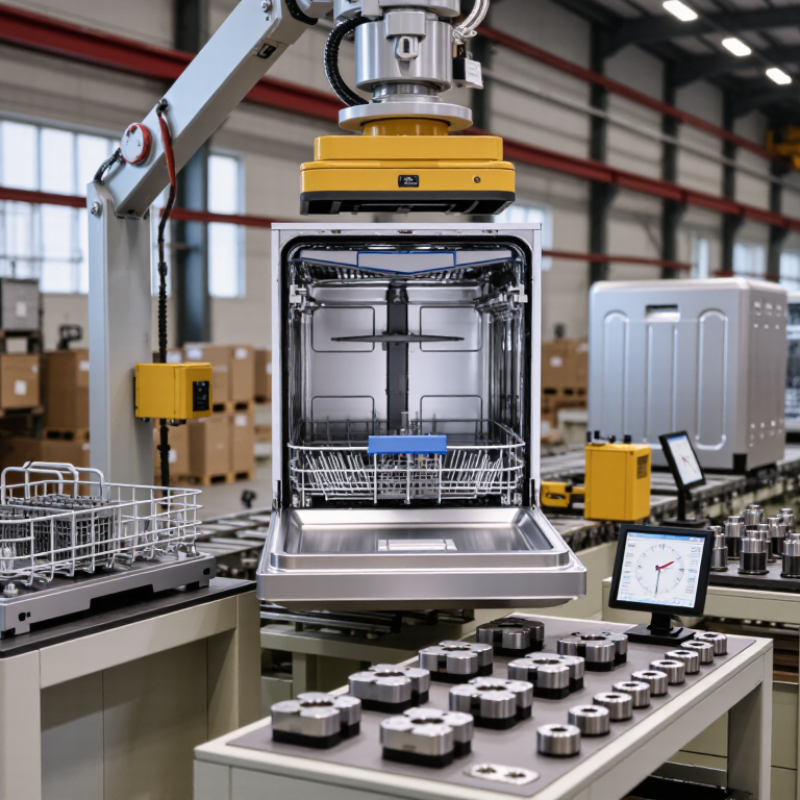
Defining Dishwasher Tooling Requirements for 2026
Defining dishwasher tooling requirements for 2026 starts with measurable performance targets, not mold size. ENERGY STAR criteria limit standard dishwashers to 3.2 gallons of water per cycle and 240 kWh annually. These figures demand accurate spray-arm geometry, stable pump housings, and tight sealing surfaces. Tooling must control shrinkage across reinforced plastics. Small warpage can create leaks, noise, or uneven cleaning.
Production teams should define cavity count, resin temperature, cycle time, and inspection points before approving tool steel. The European Commission’s product database framework measures dishwasher energy use per 100 cycles and water consumption in liters. Therefore, tooling should support repeatable hydraulic paths and consistent insulation fit. Coordinate measuring machines, pressure testing, and first-article inspections provide stronger evidence than visual checks alone. Keep critical dimensions traceable.
A perfect first mold is unrealistic. Early prototypes may expose weak ribs, trapped air, or difficult ejection. That feedback should change the tool design. It is often cheaper than correcting thousands of parts. The U.S. Department of Energy’s appliance efficiency analyses also show why annual energy and water performance matter during product development. Specify maintenance access, replaceable wear inserts, and service life targets. Tooling that runs quickly but loses precision after repeated cycles is not efficient. Design reviews should challenge optimistic assumptions.
Comparing Tooling Materials, Designs, and Manufacturing Methods
How to Choose Dishwasher Tooling in 2026?
Dishwasher tooling must survive heat, moisture, detergent, and repeated pressure. Start by matching the material to the expected production volume. Hardened tool steel suits long runs and abrasive, glass-filled plastics. Aluminum can reduce cost during prototyping, but it may wear quickly under daily production loads. Corrosion resistance matters near water channels and cavity surfaces. A small material mismatch can create burrs, stains, or unstable dimensions.
Design decisions affect both part quality and maintenance. Use balanced cooling channels to control warpage around thick ribs and corners. Proper venting helps prevent burn marks and incomplete filling. Polished cavities support smooth surfaces, but a mirror finish is not always better for every dishwasher component. Texture can hide minor marks and improve handling. Manufacturing methods also deserve careful comparison. CNC machining offers predictable accuracy, while electrical discharge machining handles deep or complex details. Replaceable inserts may cost more initially, yet they simplify future repairs. Additive tooling features can shorten development, though their cooling performance still needs validation.
Tips: Test the tooling with real detergent exposure and thermal cycling. Measure cavity wear after a defined number of shots. Do not trust the first successful sample. Check dimensions at several points, especially near clips and sealing edges. Keep records of polishing, repairs, and cycle counts. One practical lesson is easy to miss: faster production is useless when cleaning, inspection, and adjustment become constant interruptions.
How to Choose Dishwasher Tooling in 2026?
Comparing Tooling Materials, Designs, and Manufacturing Methods
This comparison uses representative engineering values for commonly selected mold-tool materials. Thermal conductivity is shown in W/m·K, hardness in HRC, and corrosion resistance is rated on a practical 1–5 scale.
H13 provides strong thermal-fatigue resistance for high-volume production, P20 offers a balanced cost and machining profile, 420 stainless steel is preferable for humid or chemically aggressive dishwasher environments, and 7075 aluminum supports rapid prototyping and shorter lead times. For production tooling, consider conformal cooling, replaceable wear inserts, CNC machining, EDM for complex details, and additive manufacturing for optimized cooling channels.
Evaluating Automation, Precision, and Smart Tooling Features
How to Choose Dishwasher Tooling in 2026?
Automation should solve a measured production problem, not decorate a factory floor. The International Federation of Robotics reported 541,302 industrial robots were installed worldwide in 2023. That growth supports robotic loading, vision inspection, and repeatable screwdriving in dishwasher production. However, tooling must match the task. A gripper handling a wet spray arm needs controlled force and corrosion-resistant contact surfaces. A fixture for door panels needs quick changeover, stable datum points, and protection against cosmetic damage. Small errors become visible gaps, vibration, or leakage.
Precision remains the foundation of smart tooling. Laser sensors can verify panel position, while torque monitoring can detect loose or over-tightened fasteners. The 2024 Deloitte Smart Manufacturing Survey found that 86% of manufacturing leaders expect smart manufacturing to become a major competitiveness driver within five years. That promise depends on usable data. Tooling should record cycle counts, force trends, calibration status, and fault history. Keep the interface simple. Operators should understand an alarm beside the line, not after a long training session.
Connected tooling sounds impressive. It can still fail. A perfect digital model cannot compensate for worn locating pins or poor maintenance. Select modular components, accessible sensors, and documented calibration routines. Test the tooling with real stainless-steel panels, damp gloves, and rushed changeovers. My own preference is conservative: automate repeated motion first, then add intelligence where it improves traceability or quality. The cheapest fixture may be expensive when every adjustment requires a technician.
Measuring Tooling Performance, Maintenance, and Lifecycle Costs
How to Choose Dishwasher Tooling in 2026?
Measuring Tooling Performance, Maintenance, and Lifecycle Costs
Choosing dishwasher tooling in 2026 requires more than comparing purchase prices. The practical question is how reliably the tool performs across production cycles. Measure cycle time, dimensional repeatability, surface quality, and reject rates during real trial runs. Record results at cold start and after extended operation. Heat, detergent exposure, vibration, and water pressure can reveal weaknesses early. Small details matter.
A useful maintenance review begins with access. Can technicians inspect wear points without removing half the assembly? Check lubrication intervals, replaceable inserts, alignment features, and cleaning effort. Use calibrated gauges and keep dated inspection records. I once saw a tool lose production hours because a simple sensor bracket was difficult to reach. That is expensive. Track unplanned downtime, repair hours, spare-part use, and maintenance frequency for each tool. Do not trust estimates alone.
Lifecycle cost should include the initial tool, installation, labor, repairs, storage, energy-related losses, and eventual refurbishment. A cheaper tool may cost more when every adjustment requires skilled labor. Calculate cost per acceptable dishwasher, not only cost per cycle. Use a twelve-month forecast, then compare it with actual records. The forecast will be imperfect. That is useful. Review the gap for optimistic assumptions about output, maintenance, or tool life. Ask suppliers for trial data, maintenance intervals, and documented wear limits before approval.
Selecting a Supplier and Validating the Final Tooling System
Choosing dishwasher tooling in 2026 starts with the supplier, not the catalog. A capable supplier should explain steel grades, cooling channels, tolerances, and maintenance access. Ask for production records from comparable plastic parts. Request sample inspection reports. Good evidence is more useful than polished promises. Visit the workshop if possible. Look closely.
Before approval, define critical dimensions, cycle targets, part weight, and expected tool life. Require a detailed design review with mold flow results and risk points. During the trial, inspect short shots, weld lines, warpage, ejection marks, and surface texture. Measure parts at room temperature and after conditioning. One measurement is not enough. Use calibrated gauges and retain the raw data. Compare actual cycle time against the quotation, not an optimistic test setting.
A reliable supplier supports revisions after sampling. Confirm who owns drawings, spare inserts, software files, and change records. Check response times through a small technical question. Delays often appear before the contract does. I have seen tools pass visual checks yet fail after repeated dishwasher cycles. That mistake is expensive. Validate heat, detergent, pressure, and repeated opening loads where relevant. The final sign-off should include a capability study and a documented acceptance list. Leave room for doubt. Tooling decisions improve when engineers record what remains uncertain.