


China Top 10 Hand Made Cleanroom Panel Suppliers?
Demand for cleanroom infrastructure is growing, but a market forecast does not prove that every supplier delivers the same quality. Grand View Research valued the global cleanroom technology market at USD 5.15 billion in 2023 and projected it could reach USD 9.58 billion by 2030. This broad market estimate includes more than wall panels. It provides context, not a guarantee of demand for any specific product. Details matter. A Hand-Made Cleanroom Panel must fit the room’s cleanliness requirements, layout, and installation conditions.
This guide introduces ten Chinese suppliers for buyers comparing panel construction, customization, and project support. ISO 14644-1 classifies cleanrooms by airborne particle concentration; it does not certify a panel manufacturer or replace project-specific testing. Buyers should therefore check documented specifications, such as core material, panel thickness, joint details, and surface finish. Ask for relevant test records and clear installation guidance, too. A neat sample is useful, but it cannot show how every joint will perform across a full room. Supplier rankings also depend on selection criteria and available evidence. No list can replace independent verification. Some company claims may be difficult to compare directly, and that is worth acknowledging. The most useful shortlist is not necessarily the one with the boldest brochure; it is the one that answers practical questions clearly and consistently.
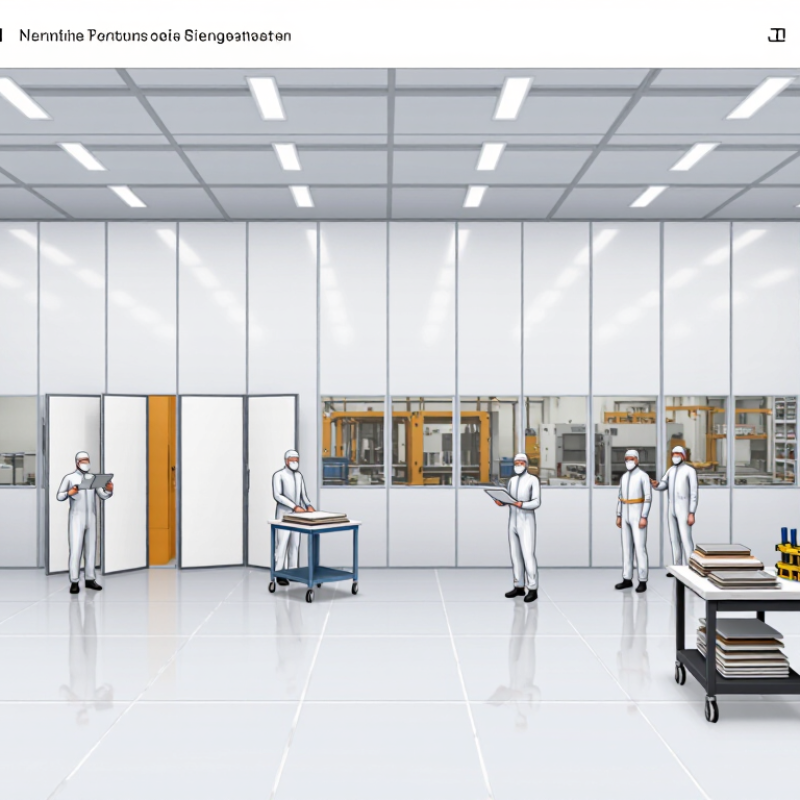
What Handmade Cleanroom Panels Are and How They Are Used
Handmade cleanroom panels are factory-assembled wall or ceiling units, usually built with metal facings and an insulated core. Common core materials include mineral wool, polyurethane, or polystyrene, selected for project-specific thermal and fire requirements. Smooth faces, sealed edges, and flush joints help limit dust-trapping ledges. Small seams matter. Panels can also be cut for doors, viewing windows, and service openings, but each cut needs careful sealing.
These panels create controlled spaces in pharmaceutical production, electronics manufacturing, laboratories, and food processing. They do not, by themselves, make a room clean. Air filtration, pressure control, cleaning procedures, and installation quality all affect performance. ISO 14644-1:2015 provides a measurable reference: at particles of 0.5 micrometres and larger, its limits are 3,520 particles per cubic metre for ISO Class 5 and 352,000 for ISO Class 7. These figures classify airborne cleanliness, not panel quality.
For a project, compare panel-joint details, core specifications, surface finish, and compatibility with cleaning agents. Ask how openings and corners will be sealed, then inspect a sample joint before installation. A neat panel face can hide uneven bonding or a poor joint. That is easy to overlook. The specification may look complete, yet the finished room still depends on careful assembly and verification.
China Top 10 Hand Made Cleanroom Panel Suppliers? - What Handmade Cleanroom Panels Are and How They Are Used
Handmade cleanroom panels are assembled from facing sheets and an insulated or structural core, then bonded and finished to suit cleanroom partitions and ceilings. The entries below are representative, unranked supplier product profiles—not verified company listings or a supplier ranking. Specifications vary by project and manufacturer; confirm test reports and drawings before purchase.
| No. | Representative supplier profile | Typical panel construction | Common thickness range | Typical use | Key specification to check |
|---|---|---|---|---|---|
| 1 | Rock-wool partition specialist | Coated steel facings with a mineral-wool core | 50–150 mm | Cleanroom walls where fire performance is a priority | Fire-test classification, core density, joint detailing, and facing finish |
| 2 | EPS-core panel producer | Color-coated steel facings with an expanded-polystyrene core | 50–100 mm | General-purpose partitions in controlled environments | Fire performance, core quality, flatness, and sealed panel joints |
| 3 | PU-core panel producer | Metal facings bonded to a polyurethane foam core | 50–100 mm | Temperature-controlled rooms and insulated clean areas | Thermal performance, fire-test evidence, and compatibility with room conditions |
| 4 | PIR-core panel producer | Metal facings with a polyisocyanurate foam core | 50–100 mm | Insulated cleanroom envelopes and temperature-controlled spaces | Product-specific fire test results, joints, and declared thermal data |
| 5 | Aluminum-facing panel fabricator | Aluminum sheet facings with a selected insulation core | 50–100 mm | Lightweight partitions and areas requiring corrosion-resistant facings | Aluminum alloy and thickness, coating, impact resistance, and edge protection |
| 6 | Stainless-steel-facing panel fabricator | Stainless-steel facings over an insulation core | 50–100 mm | Hygienic areas subject to frequent cleaning or demanding chemical exposure | Steel grade, sheet thickness, surface finish, and cleaning-chemical compatibility |
| 7 | Paper-honeycomb panel fabricator | Metal facings with a paper-honeycomb core | 50–100 mm | Lightweight partitions where high insulation or fire performance is not the primary requirement | Moisture exposure, load requirements, edge sealing, and applicable fire requirements |
| 8 | Gypsum-core panel fabricator | Metal facings with a gypsum-based core | 50–100 mm | Interior partitions where a rigid, smooth surface is required | Moisture suitability, panel weight, fire documentation, and joint sealing |
| 9 | Cleanroom ceiling-panel fabricator | Insulated sandwich panels with ceiling-compatible joints and support details | 50–100 mm | Suspended or supported cleanroom ceilings | Span and support design, service cut-outs, load limits, and airtightness |
| 10 | Custom-cut panel fabricator | Project-specified facings and core, with factory-cut openings or shaped edges | Project-specific; commonly 50–150 mm | Rooms requiring doors, windows, pass-throughs, or equipment openings | Approved shop drawings, dimensional tolerances, reinforced openings, and sealed cut edges |
Panel thicknesses shown are common indicative ranges, not a universal standard. Select panels according to the room design, fire and building-code requirements, cleaning regime, mechanical loads, and the manufacturer’s documented test data.