

• Gantry Robot Manufacturer & Articulated Arm Integrator

China Top Automated Line Manufacturers for Global Buyers

China is a major sourcing destination for production equipment, but choosing a supplier takes more than comparing prices. For global buyers, an Automated Line must fit the product, factory layout, target output, and available workforce. A system that looks impressive in a brochure may still need substantial adjustment on the shop floor. Details matter.

This guide introduces leading Chinese automated line manufacturers and the capabilities buyers can evaluate. These include machine design, robotics, controls, material handling, inspection, and integration with existing equipment. Buyers should also review project references, component specifications, quality procedures, installation support, and spare-parts availability. Ask for clear cycle-time assumptions and acceptance criteria. A sample video helps, but it cannot replace a well-defined factory acceptance test.

No supplier is the right choice for every project. Some excel at standard machinery, while others focus on custom production cells or complete turnkey systems. Communication, documentation, and after-sales service can be just as important as engineering. They are sometimes underestimated. This comparison is a starting point, not a guarantee of performance; actual results depend on product design, operating conditions, and commissioning. Before making a decision, confirm requirements directly with shortlisted manufacturers and check that their proposed solution matches the intended production process.
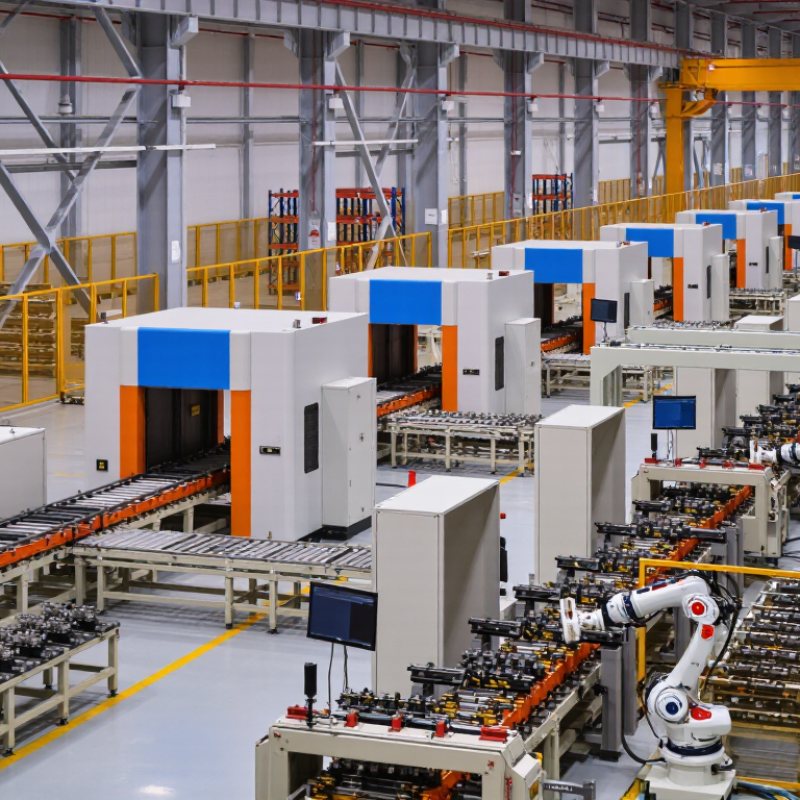
China Top Automated Line Manufacturers for Global Buyers

Automated Production Lines: Core Modules, Controls, and Integration Scope

A reliable automated production line is more than connected machines. It combines material handling, processing stations, inspection, safety equipment, and controls. In a packaging line, for example, conveyors must deliver containers at a steady pitch while sensors detect jams and reject misfilled units. Small timing errors can stop the entire line. That detail matters.

The International Federation of Robotics reported 541,302 industrial robot installations worldwide in 2023, with 4,281,585 robots operating in factories. These figures, published in World Robotics 2024, show the scale of automation—not that every process needs a robot.

Buyers should define cycle time, product variation, changeover frequency, and inspection requirements before comparing proposals. Control scope should specify PLC logic, operator interfaces, safety circuits, data logging, and interfaces with existing systems.

Integration is where assumptions often fail. A quoted line may exclude upstream feeding, plant-network work, or production-data mapping. Request an interface list, acceptance criteria, and test records.

The IFR’s World Robotics 2024 also reported global robot density of 162 robots per 10,000 manufacturing employees in 2023. This is useful context, not a productivity guarantee; layout, maintenance skills, and spare-parts access still shape real output.

China’s Automation Scale: 276,288 Robot Installations in 2023 (IFR)

China Top Automated Line Manufacturers for Global Buyers

China’s Automation Scale: 276,288 Robot Installations in 2023 (IFR)

China installed 276,288 industrial robots in 2023, according to the International Federation of Robotics. That represented about 51% of global installations that year. The scale matters to buyers because it supports a broad manufacturing ecosystem, including integrators, component suppliers, and experienced engineering teams. A busy factory floor may show robots tending machines, moving parts, or welding repeatable assemblies. Still, a national figure cannot confirm the quality of any individual production line. That matters.

Tips: Ask for cycle-time data from a similar application. Check how changeovers, safety systems, and maintenance access work in practice. Request clear acceptance criteria before ordering.

For global buyers, automation should be assessed against the product, not the headline number. Compare output targets with realistic uptime assumptions, and ask how faults are diagnosed remotely. Review spare-parts plans and operator training, too. These details can reveal gaps that a polished demonstration misses. A supplier may provide strong equipment, yet commissioning can still take longer than expected. That is worth discussing early. A small pilot run, with actual parts and documented results, can make the decision more grounded.

Chinese Line-Maker Categories Across Automotive, Electronics, and Batteries

Automotive line makers typically design equipment for welding, painting, and final assembly. Their systems may combine robots, conveyors, inspection stations, and safety controls. A body-in-white line, for example, must hold panels steady while welds are placed at repeatable points. Small alignment errors can create costly rework. Still, automation does not remove every production problem; product changes can require tooling updates and careful retesting.

Electronics line makers focus on compact, precise processes such as surface mounting, soldering, testing, and board handling. Small tolerances matter. A misplaced component or inconsistent solder joint may affect later performance, so vision inspection and process records are useful. Buyers should ask how a line handles different board sizes, changeovers, and defect reporting, rather than judging it by speed alone. Fast is not always better.

Battery line makers serve processes including cell sorting, module assembly, pack integration, and end-of-line testing. These lines need controlled handling and traceable quality checks, especially when cells vary slightly in dimensions or electrical behavior. Temperature monitoring and clear fault procedures matter. Not every supplier has equal experience across cell formats, so request process examples and acceptance criteria. A factory visit can reveal practical details, though one visit is only a snapshot.

China’s Robot Density Reached 470 per 10,000 Manufacturing Workers in 2023 (IFR)

China’s robot density reached 470 robots per 10,000 manufacturing workers in 2023, according to the International Federation of Robotics (IFR). The figure offers global buyers a useful snapshot of China’s growing automation capacity. On a factory floor, robots may handle welding, loading, inspection, or repetitive assembly. A well-integrated line can help maintain consistent cycle times across shifts. That matters.

However, robot density is a national measure, not a guarantee that every supplier uses advanced automation. A highly automated cell can still slow down if part feeding, safety controls, or quality checks are poorly coordinated. Buyers should look beyond robot counts. Ask how equipment communicates across the line, how quickly product changeovers are completed, and what support is available when a sensor or gripper fails. A polished demonstration is helpful, but a production trial reveals more.

Tips: Request a sample cycle-time report and a clear description of inspection steps. Check whether operators can safely manage routine adjustments. If possible, observe the line running with your own parts. Small gaps often appear during changeovers, not during a staged presentation.

China Top Automated Line Manufacturers for Global Buyers - China’s Robot Density Reached 470 per 10,000 Manufacturing Workers in 2023 (IFR)

Robot density is the number of operational industrial robots per 10,000 manufacturing workers.
Rank Economy Robot density (2023) Compared with world average* Automation context for global buyers
1 South Korea 1,012 6.25× Highest density among the economies listed; reflects extensive industrial robot use.
2 Singapore 770 4.75× A highly automated manufacturing base, with robot deployment well above the global average.
3 China 470 2.90× China ranked among the world’s leading manufacturing economies for robot density in 2023.
4 Germany 429 2.65× Robot density was close to China’s, providing a useful benchmark for mature manufacturing automation.
5 Japan 419 2.59× A long-established automation market with robot density above twice the global average.
6 Sweden 347 2.14× Robot density indicates substantial use of industrial robots in manufacturing.
7 Denmark 306 1.89× A European benchmark with robot density notably above the global average.
8 United States 295 1.82× Robot density exceeded the 2023 global average.
World average 162 1.00× Global reference value for comparing manufacturing robot adoption.

Source: International Federation of Robotics (IFR), World Robotics 2024. *Multiples are calculated by dividing each economy’s 2023 robot density by the world average of 162.

Global Vendor Checks: ISO 10218, CE Marking, FAT, and SAT

For global buyers, a supplier’s safety documents deserve the same attention as its cycle-time claims. Ask how the proposed robotic cell addresses ISO 10218 requirements for industrial robots and their applications. The answer should connect standards to actual safeguards: perimeter fencing, interlocked access doors, emergency stops, and validated operating modes. A certificate alone is not enough. Request the relevant scope and supporting risk-assessment records.

For equipment entering the European market, CE marking indicates the manufacturer’s declared conformity with applicable requirements. It is not a general quality award. Check the declaration, machine configuration, and technical documents against the delivered line. If a safety scanner or guarding layout changes late, ask whether the assessment and documents were updated. Small changes matter.

FAT and SAT turn promises into observable checks. During the factory acceptance test, run representative parts and record cycle times, alarms, changeovers, and safety functions. Keep the test criteria agreed in writing. At the site acceptance test, repeat key checks after installation, with actual utilities, operators, and upstream equipment. Watch a full production shift if practical. One polished demonstration can hide awkward recovery steps. Even careful testing leaves gaps; document open issues, owners, and deadlines before sign-off.