

• Gantry Robot Manufacturer & Articulated Arm Integrator

China Top Electric Generator Manufacturers and Suppliers

China’s Electric Generator industry supports hospitals, factories, construction sites, data centers, and remote infrastructure. Reliability matters when a utility line fails at 2 a.m.

The International Energy Agency’s Electricity 2024 report forecasts strong global electricity demand growth through 2026. That outlook increases the need for dependable backup and prime-power equipment. China’s expanding manufacturing base also strengthens its role in generator production and export supply chains. The China Electricity Council reported that China’s total installed power-generation capacity exceeded 3.3 billion kilowatts by the end of 2024. This scale creates deep experience in engines, alternators, control systems, and power management.

This guide reviews leading Chinese manufacturers and suppliers by product quality, production capability, certifications, service coverage, and application experience. It considers diesel, natural-gas, and hybrid generator solutions. ISO 8528 performance standards, ISO 9001 quality systems, and destination-market certifications deserve close attention. Factory testing should include load-bank results, voltage stability, fuel consumption, noise levels, and emergency-start performance. Small details matter. A generator may look impressive in a brochure but perform differently under a dirty, hot, or overloaded site condition.

Market rankings are not permanent. Supplier visibility can reflect marketing rather than engineering strength. Buyers should verify test documents, warranty terms, spare-parts availability, and local technical support before signing contracts. Reports from MarketsandMarkets and Grand View Research indicate continued growth in global generator demand, but forecasts vary by methodology. That uncertainty deserves honest consideration. A practical supplier is not always the largest one. It is the one that delivers stable power when conditions become difficult.
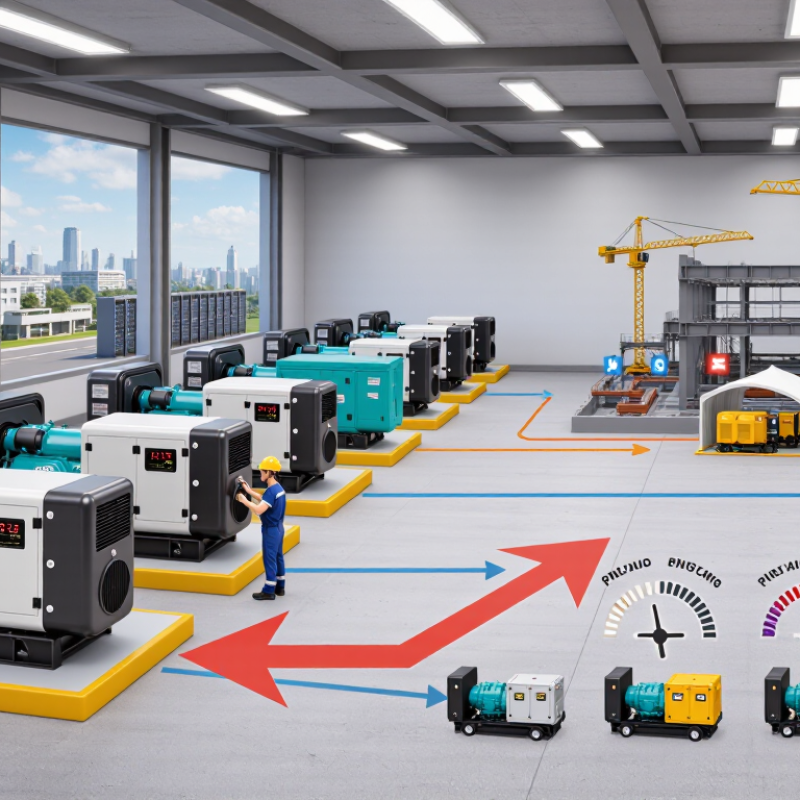
China Top Electric Generator Manufacturers and Suppliers

Electric Generator Manufacturing in China: Industry Overview

China’s electric generator manufacturing industry is moving beyond low-cost production. It now combines engine assembly, alternator design, control systems, testing, and export services. The China Electricity Council reported national electricity consumption of about 9.22 trillion kWh in 2023. Installed generation capacity reached roughly 2.92 billion kW. These figures support steady demand for standby, prime, and emergency power equipment.

The International Energy Agency’s Electricity 2024 report identifies China as a major contributor to global electricity-demand growth through 2026. This trend supports investment in data centers, factories, hospitals, ports, and construction sites. Chinese manufacturers are responding with diesel, gas, hybrid, and battery-assisted generator systems. Production lines commonly include load-bank testing, vibration checks, fuel-consumption measurement, and noise control. Small details matter. A loose cable can delay commissioning.

Quality is uneven. That needs honest attention. Some factories provide strong traceability, while others rely too heavily on visual inspection. Buyers should review ISO 9001 procedures, emissions documentation, factory test records, and after-sales response times. The International Organization for Standardization notes that quality management depends on controlled processes, not certificates alone. Exporters also need product configurations suited to local voltage, frequency, climate, and grid codes. A generator designed for a dry inland site may perform poorly in coastal humidity. China remains highly competitive, but technical verification must accompany price comparisons.

Key Types of Electric Generators Made by Chinese Companies

Chinese generator manufacturers produce several key types for construction, hospitals, factories, farms, and emergency sites. Diesel generators remain popular because they deliver stable power under heavy loads. Common models use liquid-cooled engines, automatic transfer switches, and sound-attenuated enclosures. Natural-gas generators offer cleaner operation where pipeline fuel is available. They suit commercial buildings and continuous-power projects. Portable gasoline generators serve smaller loads, such as tools, outdoor equipment, and temporary lighting.

Hybrid systems are gaining attention. They combine diesel or gas units with solar panels, batteries, and smart controls. The IEA Electricity 2024 report expects global electricity demand to grow by about 4% in 2024 and 2025. Meanwhile, the IEA Renewables 2024 report recorded nearly 510 GW of renewable capacity added worldwide in 2023. These figures explain the growing interest in low-emission backup systems. Still, hybrid performance depends on battery temperature, load patterns, and local sunlight. Marketing claims can sound cleaner than real jobsite results.

Tips: Match generator size to starting current, not only running watts. Check fuel quality, noise ratings, cooling design, and service access. Ask for test records under realistic loads. A smaller unit may consume less fuel, but undersizing can damage equipment. This is easy to overlook. Verify applicable safety standards and grid-connection rules before purchase.

China Top Electric Generator Manufacturers and Suppliers - Key Types of Electric Generators Made by Chinese Companies

Generator Type Typical Power Range Primary Fuel or Energy Source Output Configuration Cooling Method Common Applications Main Advantages
Diesel Generator Sets Approximately 5 kVA to more than 3,000 kVA Diesel fuel Single-phase or three-phase AC; 50 Hz or 60 Hz versions Radiator-based liquid cooling; smaller units may use air cooling Factories, construction sites, telecommunications, hospitals, data centers, and standby power systems High durability, strong load capacity, reliable long-duration operation, and broad power coverage
Gas Generator Sets Approximately 20 kW to several megawatts Natural gas, biogas, landfill gas, or other approved gaseous fuels Usually three-phase AC; commonly configured for continuous or standby operation Liquid-cooled engine systems Commercial buildings, industrial facilities, combined heat and power systems, and distributed energy projects Lower local emissions than conventional diesel units when supplied with suitable natural gas
Gasoline Portable Generators Approximately 0.8 kW to 15 kW Gasoline Single-phase AC, often with 12 V DC auxiliary output Air-cooled Home backup, outdoor activities, small workshops, agricultural work, and emergency use Lightweight design, simple operation, and relatively low initial purchase cost
Inverter Generators Approximately 1 kW to 8 kW Usually gasoline; some models support liquefied petroleum gas Stable single-phase output produced through AC-DC-AC conversion Air-cooled Sensitive electronics, recreational vehicles, camping, residential backup, and mobile work Lower noise, improved fuel efficiency at partial load, compact size, and clean voltage waveform
Dual-Fuel Generators Approximately 2 kW to 20 kW for portable models Gasoline and liquefied petroleum gas Primarily single-phase AC; selected larger systems are three-phase Air-cooled or liquid-cooled, depending on output rating Residential backup, emergency response, mobile services, and remote work locations Fuel flexibility and extended operating options when one fuel is unavailable
Natural Gas Standby Generators Approximately 8 kW to 150 kW for residential and light commercial systems Pipeline natural gas or liquefied petroleum gas Single-phase or three-phase AC with automatic transfer switch compatibility Liquid-cooled on higher-output models; air-cooled on smaller units Homes, offices, retail facilities, farms, and small commercial buildings Automatic emergency start capability and no on-site diesel storage requirement
Solar-Battery Generator Systems Approximately 0.5 kWh to more than 20 kWh of stored energy per system Solar photovoltaic modules and rechargeable batteries Inverter-based AC output with DC charging and storage functions Passive or fan-assisted battery and inverter cooling Backup power, outdoor use, disaster preparedness, telecommunications, and off-grid applications Quiet operation, zero fuel combustion during use, modular expansion, and low routine maintenance
PTO Generators Approximately 10 kW to 150 kW Mechanical power from a tractor power take-off shaft Usually three-phase AC; some models provide single-phase output Air-cooled or fan-assisted alternator cooling Agriculture, livestock farms, irrigation systems, and rural emergency power Uses existing tractor equipment and can reduce the need for a separate engine

Note: Power ranges are typical market categories and may vary by configuration, engine, alternator, operating mode, voltage, frequency, and applicable standards.

How to Evaluate Chinese Generator Manufacturers and Suppliers

Evaluating Chinese generator manufacturers and suppliers requires more than comparing quoted prices. A reliable assessment begins with the factory, not the sales brochure. Request a live video tour or schedule an independent site inspection. Check whether the facility has organized assembly lines, calibrated testing equipment, and traceable quality records. Ask who builds the engine, alternator, control panel, and enclosure.

Technical documents should match the proposed generator. Review rated and standby power, fuel consumption, noise levels, voltage stability, and operating temperature. Request a witnessed load test with clear readings at 25%, 50%, 75%, and 100% capacity. Certificates matter, but verify their issuing bodies and product coverage. Paperwork alone proves little.

I also examine service capability before signing. Ask for spare-parts lists, response times, wiring diagrams, and technician training records. Speak with two or three previous export customers, preferably in similar climates. Inspect packaging details, including moisture protection and shock indicators. A low price may hide weak after-sales support. I have seen attractive quotations exclude commissioning, replacement parts, or transport damage protection. That mistake is expensive.

Communication reveals practical competence. Can the supplier explain maintenance intervals in plain language? Do answers remain consistent across sales, engineering, and quality teams? No checklist is perfect. My own evaluation can still miss hidden subcontracting or rushed testing. A small trial order and independent inspection usually expose more than a long presentation.

Leading Regions and Production Capabilities in China

China’s electric generator manufacturing base is spread across several powerful industrial regions. Jiangsu supports large-scale generator set production, with strong machining, assembly, and electrical integration capabilities. Zhejiang is known for compact units, engine components, control panels, and flexible private manufacturing. Guangdong benefits from advanced electronics, dense supplier networks, and efficient export logistics. Shandong and Fujian also contribute through engine manufacturing, alternators, and heavy-duty equipment production.

Regional specialization affects sourcing decisions. A factory near Shanghai may offer faster access to testing facilities, ports, and international freight services. Southern manufacturers often respond quickly to customized voltage, enclosure, and control requirements. Many established facilities maintain load banks, noise testing rooms, insulation testers, and automated winding equipment. These resources help verify output stability under changing loads. Buyers should review factory audits, production records, warranty procedures, and independent inspection reports. Documents matter, but observed processes matter more. Ask to see a full-load test.

Production capacity is not measured by floor area alone. Skilled technicians, reliable component suppliers, spare-part systems, and quality controls often decide delivery performance. Some suppliers appear highly capable but outsource critical assemblies without clear supervision. That creates avoidable uncertainty. Factory visits can reveal practical details, such as cable routing, oil-leak checks, welding quality, and packing protection. Certification can support trust, but it does not replace technical verification. Specifications also require careful review, especially for fuel consumption, acoustic levels, transient response, and operation at high temperatures. Mistakes still happen. Careful buyers leave room for testing, correction, and realistic delivery schedules.

Purchasing, Certification, and Supplier Selection Considerations

Selecting a generator supplier requires more than comparing rated kilowatts. IEA’s Electricity 2024 report projects global electricity demand to grow by about 3.4% annually from 2024 to 2026. This growth increases pressure on hospitals, factories, construction sites, and data facilities to secure dependable backup power. Buyers should calculate starting loads, continuous loads, fuel autonomy, altitude, ambient temperature, and service access before requesting quotations.

Certification deserves careful checking. ISO 8528-1 defines generator rating categories, while ISO 8528-5 addresses performance requirements for generating sets. Ask suppliers for current test reports, factory inspection records, emissions documents, and traceable serial numbers. A certificate without a matching engine, alternator, and control-system configuration proves very little. This is often overlooked.

Look beyond the lowest price. A supplier should provide load-bank testing, spare-parts planning, operator training, and response-time commitments. The World Bank’s Logistics Performance Index 2023 shows that delivery reliability remains a practical business concern across global supply chains. Therefore, confirm production capacity, export documentation, packaging standards, and local technical support. A spreadsheet can still lie. No checklist is perfect. Buyers should challenge unclear efficiency figures and request site-specific references. In some cases, paying more for verified testing and faster maintenance reduces operational risk, even when the initial quotation feels uncomfortable.