

China has a broad network of manufacturers producing Erw Galvanized Pipe for construction, water systems, fencing, and industrial projects. Yet a polished catalogue cannot show how consistently a pipe is made. Buyers need to look beyond price and compare manufacturing controls, product specifications, and the evidence behind quality claims.
As a practical editorial viewpoint, Lin Wei, a composite pipe-quality specialist created for this introduction, puts it this way: “A dependable galvanized pipe begins with sound weld control and ends with a coating that matches the service environment.” This is an illustrative quotation, not a statement attributed to a documented real person. The point is worth checking. Weld quality, zinc-coating consistency, dimensional tolerances, and test records can all affect a product’s suitability.
This “Top 10” guide is intended as a shortlist, not a guarantee that one supplier fits every project. It considers factors such as product range, production capability, quality documentation, customization, and export support. Ask for current specifications and inspection records. Check details.
Even a capable manufacturer may not suit every application. Confirm diameter, wall thickness, coating requirements, applicable standards, packaging, and delivery terms before requesting a quote. Those checks take time. They can also reveal gaps that a sales brochure leaves out.
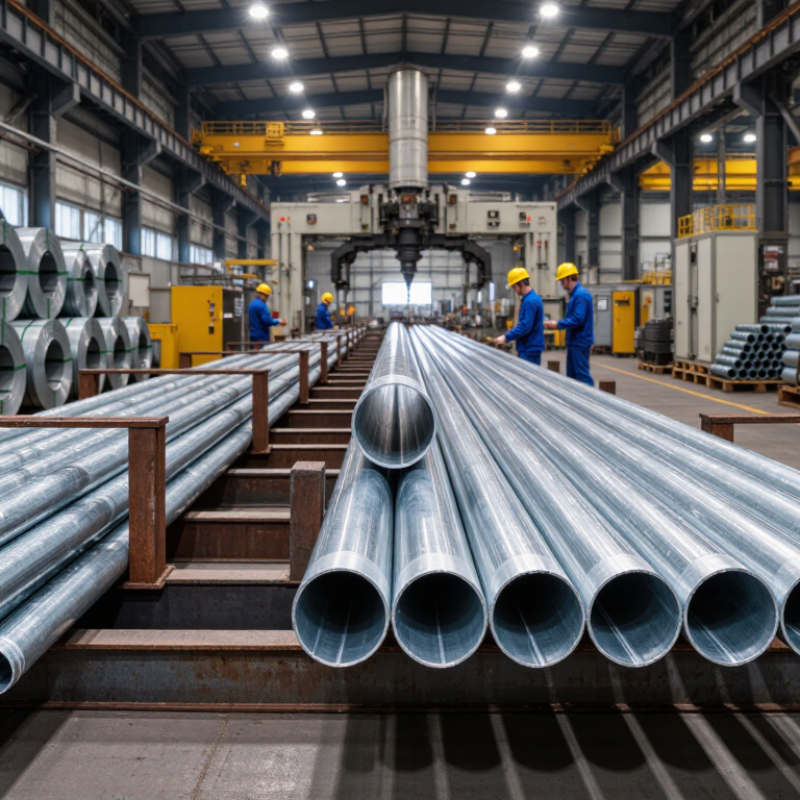
Top 10 ERW Galvanized Pipe Manufacturers in China
ERW Galvanized Pipe Basics: Welded Seams, Zinc Coatings, and Applications
ERW galvanized pipe starts as flat steel strip, formed into a tube and joined along a straight seam using electric resistance welding. The seam is part of the pipe, not a separate fitting. Depending on the production route, zinc may be applied before or after welding. Coating coverage inside the pipe can vary, so check the stated process and specifications.
Tips: Confirm outside diameter, wall thickness, zinc coating requirements, and seam inspection records before ordering. Look closely at cut ends and threaded areas; exposed steel can corrode sooner. Small details matter.
Zinc forms a protective barrier and can help protect exposed steel sacrificially, but it is not damage-proof. Scratches, poor storage, and trapped moisture may shorten service life. ERW galvanized pipe is commonly used for fencing, scaffolding, frames, and water distribution in suitable systems. For pressure or potable-water use, verify that the pipe meets the project’s applicable specifications. A bright surface alone tells you little about coating consistency. Even experienced buyers can miss that.
ERW galvanized pipe production starts with a flat steel strip selected for thickness, width, and intended service. Leveling rolls remove coil set, while forming stands gradually bend the strip into a round tube. The edges meet under controlled pressure. High-frequency current heats them rapidly, and squeeze rolls forge a continuous weld. No filler metal is normally added. Operators monitor temperature, line speed, and edge alignment because small shifts can affect seam consistency. Small details matter.
After welding, the tube is sized, cut to length, and checked for visible defects and dimensional tolerance. For many finished pipes, galvanizing follows forming through cleaning, fluxing, and immersion in molten zinc. Some products use pre-galvanized strip instead, so the route can vary. The zinc coating helps protect exposed steel, but coverage depends on surface preparation and process control. This step is easy to underestimate. Rough patches near an end may signal handling damage or uneven coating and deserve inspection. Depending on the specification, checks can include coating mass, dimensions, and weld integrity. A pipe may look bright and still need testing; appearance alone is not a reliable acceptance method.
GB/T 3091-2015 sets a 300 g/m² average zinc-coating benchmark for galvanized steel pipes. Its minimum for an individual test result is 270 g/m². These figures describe coating mass, not a visual impression of thickness. A bright, even surface can still hide thin spots near welds, cut ends, or the pipe interior. Appearance helps, but it cannot replace measurement.
For purchasing checks, ask for batch-specific test records, sampling details, and the method used to measure coating mass. The gravimetric approach specified in GB/T 13825 provides a measurable basis for comparison. World Steel Association’s World Steel in Figures 2024 reports global crude steel production of 1,892.2 million tonnes in 2023; that broad industry scale makes traceable quality checks especially useful. It is not a galvanized-pipe production figure, though.
One caution: a certificate alone does not prove every pipe meets the average. I would compare test results with the stated batch and inspect both ends. Small details matter.
China’s leading ERW galvanized pipe makers vary in product range, coating control, and export experience. Many supply round pipes for water lines, scaffolding, fencing, and general construction. Some also produce square or rectangular sections. Buyers should compare wall thickness, outside diameter, zinc coating mass, and permitted tolerances—not just price. Small differences matter.
Certification claims need careful checking. A factory may hold a quality management certificate, while individual products require separate test records. Ask for current certificates, mill test reports, and details of the applicable product standard. Confirm that documents match the actual pipe dimensions and coating specification. Requesting a sample can reveal rough weld seams, uneven galvanizing, or sharp cut ends. It is a practical step. Not foolproof.
Export markets include Southeast Asia, the Middle East, Africa, and parts of Europe, though requirements differ by project and destination. Established suppliers often offer container packing, length customization, and surface protection for shipping. Still, delivery times and coating consistency can vary between production batches. Buyers should verify inspection methods, packing details, and after-sales procedures before placing large orders. No catalogue tells the whole story.
Top 10 ERW Galvanized Pipe Manufacturers in China
A supplier comparison should begin with the pipe, not the brochure. Match the stated outside diameter and wall thickness to your drawing, then check sample measurements with a calibrated micrometer. Ask whether tolerances apply to each pipe or only to an average. A compliant average can hide a thin section. Also confirm the measurement locations, especially near the weld seam and pipe ends.
Coating mass deserves its own line in the comparison sheet. ASTM A53/A53M specifies a minimum zinc coating weight of 0.55 kg/m² for galvanized pipe; ASTM A90/A90M describes the coating-weight test. Request the measured result, test method, sample size, and batch identification—not just “meets standard.” Useful records include dimensional inspection, hydrostatic or nondestructive testing, and applicable tensile or flattening results. Check that report numbers match the production lot and stated grade. Small details matter.
A spreadsheet can look reassuring. It is not proof. Ask for a recent, traceable test report and clarify whether testing was witnessed or performed in-house. Compare coating results across several production batches where possible; one strong sample may not represent routine output. Suppliers sometimes provide incomplete data, and buyers can overlook that gap. Flag it before placing an order.
| Anonymous Comparison Profile | Indicative Outside-Diameter Range | Indicative Wall-Thickness Range | Coating-Mass Range to Confirm | Useful Test Data to Request | Key Questions for Supplier Evaluation |
|---|---|---|---|---|---|
| Supplier 01 Small-diameter general-purpose pipe | 21.3–60.3 mm | 1.8–3.5 mm | 275–550 g/m², subject to product standard and agreed measurement method | Mill test certificate; dimensional inspection; zinc-coating test; hydrostatic or applicable alternative test | Are diameter and wall thickness nominal or actual? Can the supplier provide measured readings by heat or lot? |
| Supplier 02 Scaffolding and structural tube | 33.7–76.1 mm | 2.0–4.0 mm | 275–600 g/m², with the coating standard and sampling basis stated | Steel grade and heat number; tensile properties; dimensional checks; coating-thickness or coating-mass results | Does the offered grade and product standard match the intended structural or scaffolding application? |
| Supplier 03 Medium-diameter water-service pipe | 60.3–114.3 mm | 2.3–5.0 mm | 300–600 g/m², depending on specification and agreed acceptance criteria | Hydrostatic test record where required; visual inspection; coating continuity and adhesion checks | What test pressure, hold time, sampling frequency, and acceptance criteria will appear on the inspection report? |
| Supplier 04 Large-diameter line and utility pipe | 114.3–219.1 mm | 3.0–6.0 mm | 275–600 g/m²; confirm whether the value is an average, minimum, or nominal target | Hydrostatic or specified leak test; outside-diameter and wall-thickness readings; coating inspection | Can the supplier document inspection results for the full ordered size range, including pipe ends? |
| Supplier 05 Light-wall conduit and general fabrication tube | 21.3–88.9 mm | 1.5–3.0 mm | 275–450 g/m², to be checked against the purchase specification | Dimensional report; surface inspection; coating test; material certificate with traceable heat identification | Are minimum wall thickness and permitted tolerances explicitly stated on the quotation and order? |
| Supplier 06 Heavy-wall mechanical and structural tube | 48.3–168.3 mm | 3.2–6.0 mm | 300–600 g/m², depending on the agreed galvanizing route and standard | Mechanical-property results; dimensional inspection; coating mass or thickness report; weld-seam inspection as specified | Is galvanizing performed before or after forming, and how are cut ends and weld seams protected? |
| Supplier 07 Mixed-size project supply | 21.3–168.3 mm | 1.8–5.5 mm | 275–600 g/m², with results reported by size and production lot | Lot-based material certificates; dimensional records; coating results; test records linked to bundle or batch numbers | Can traceability be maintained when several diameters, wall thicknesses, and grades share one shipment? |
| Supplier 08 Custom-length and cut-to-order tube | 26.9–114.3 mm | 2.0–5.0 mm | 275–550 g/m², subject to the agreed coating requirement | Length and end-condition inspection; coating checks after cutting; applicable pressure or leak-test records | Are length tolerance, end finish, bundling, and post-cut corrosion protection included in the specification? |
| Supplier 09 Export-oriented standard-size pipe | 21.3–219.1 mm | 1.8–6.0 mm | 275–600 g/m²; confirm the governing standard rather than comparing coating values alone | Certificate of conformity; material and dimensional reports; coating test results; inspection records in the agreed language | Does the supplier quote to the buyer’s specified standard and edition, with third-party inspection if requested? |
| Supplier 10 Broad-range production capability | 21.3–219.1 mm | 1.8–6.0 mm | 275–600 g/m² as an indicative comparison band, not a universal requirement | Heat-traceable material certificate; dimensional report; coating report; required hydrostatic, leak, or weld inspection data | Request recent, redacted sample reports for the exact size, grade, coating route, and standard being purchased. |
| Important: These anonymous profiles are comparison placeholders, not verified claims about specific manufacturers. The ranges are indicative market-screening bands and are not guaranteed product specifications. Actual availability, tolerances, coating requirements, test methods, and acceptance limits vary by product standard, grade, size, and purchase order. Confirm each item against the applicable standard and obtain lot-specific inspection documents before purchase. Coating mass and coating thickness are not interchangeable unless the specified test method defines the conversion and acceptance basis. | |||||


