

• Gantry Robot Manufacturer & Articulated Arm Integrator

Top 10 Heat Gun Manufacturers for Global Buyers

Choosing a Heat Gun for a business or workshop involves more than comparing maximum temperature. Airflow stability, control accuracy, grip comfort, and service support can matter just as much. A tool that performs well on a product page may feel different during a long shift. Details matter.

This guide introduces ten manufacturers serving global buyers, from established power-tool brands to specialists with focused heat-processing ranges. It considers practical factors such as temperature settings, nozzle options, cord length, voltage availability, warranty terms, and access to replacement parts. These points help buyers compare equipment for tasks such as shrinking tubing, removing paint, or shaping materials, while following each tool’s instructions and safety guidance.

A ranking cannot fit every workshop. Some manufacturers offer broad distribution, while others may provide features better suited to a particular application or budget. Published specifications are useful, but they do not always explain how comfortably a tool handles repeated use. That gap deserves a closer look. The manufacturers below are therefore presented as options to investigate, not as a universal verdict. Buyers should confirm current specifications, regional service arrangements, and compatibility with their work before ordering. Availability and product details can change, so a careful check with the manufacturer or authorized seller remains worthwhile.
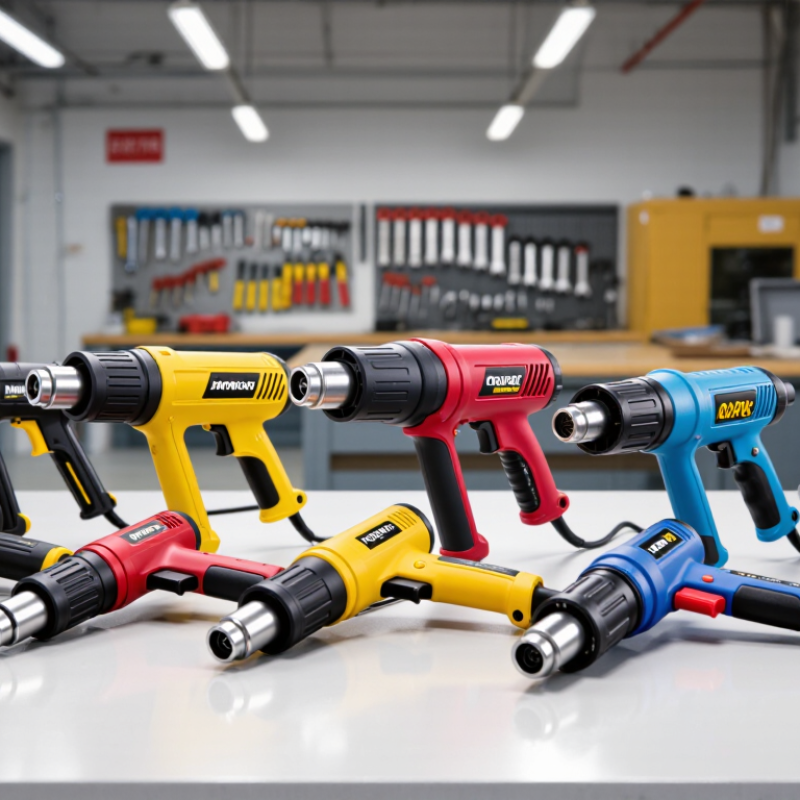
Top 10 Heat Gun Manufacturers for Global Buyers

Heat Guns: Main Types, Uses, and Essential Features

Heat guns are often grouped by control style: basic single-setting models, variable-temperature tools, and digital units with preset or precise adjustment. Basic models suit occasional shrink tubing or loosening adhesive. Variable control gives better handling when warming paint, bending plastic sheet, or drying a damp surface. Digital displays help repeat settings, though the displayed temperature may differ from heat at the workpiece.

Airflow matters as much as heat. A narrow nozzle concentrates warmth on a small area; a reflector nozzle spreads it around tubing. Scraper attachments can help lift old coatings, but they do not make every surface heat-resistant. Keep the nozzle moving. Avoid overheating nearby wires, glass, or finished wood. A high maximum temperature looks impressive, but it is not always useful.

For global buyers, check voltage, plug format, and stated frequency before comparing models. Also examine cord length, grip comfort, overheat protection, and whether the tool can stand upright during cooling. Small details matter. A heavy unit may feel stable at a bench but tiring overhead. Temperature figures alone are imperfect guides; airflow, nozzle choice, distance, and the material itself change the result. Test on a hidden area when the finish is uncertain.

How Heat Guns Are Made and Tested

Heat gun production begins with a defined layout: a heating element, insulated airflow path, motor, switch, and heat-resistant housing. Components are checked before assembly for dimensions, electrical continuity, and visible damage. Workers fit the element into a ceramic or mica support, then position the fan and wiring to maintain clearance from hot surfaces. The casing is closed only after connections are inspected. Small assembly errors matter.

Testing checks both performance and safety. A unit may run at different settings while technicians measure outlet temperature, airflow, and warm-up time. They also inspect electrical insulation and confirm that controls respond as intended. Some production lines test every unit; others combine sample testing with routine checks. A smooth casing is reassuring, but it proves little about internal wiring. Even careful sampling can miss a defect, so traceable records and consistent inspection procedures are important.

Tips: For purchasing evaluations, ask how temperature accuracy, airflow, and overheat protection are verified. Compare test records for models with similar power and intended use. Look for repeatable results, not just a single impressive reading. No test catches everything. A clear account of limits builds more trust than a perfect-sounding claim.

What Global Buyers Should Look for in a Manufacturer

Global buyers should look beyond a heat gun’s advertised wattage. Ask how the manufacturer controls temperature, airflow, and consistency between units. A useful evaluation includes checking several samples, not just one polished demonstration model. Does the tool hold a steady setting during a ten-minute test? Is the nozzle secure after repeated heating and cooling? Small details matter.

Ask for clear test records, component specifications, and quality-control procedures. The manufacturer should explain how it checks insulation, cord strain relief, and overheating protection. Request documentation for the safety and performance requirements in your destination market; requirements can differ. Check whether manuals include accurate operating limits and maintenance instructions. Vague answers are a warning.

Then examine production capacity and service support. Can the supplier maintain the same specifications across a large order? What happens when a unit fails, or replacement parts are needed months later? Get response times and warranty terms in writing. A factory visit or independent inspection can reveal more than a brochure, though neither guarantees future consistency. I would also compare packaging and drop-test practices: a sound tool can still arrive damaged after a rough shipment. No supplier is flawless, and a rushed audit may miss things. Probe the weak spots.

Top 10 Heat Gun Manufacturers for Global Buyers

Top 10 Heat Gun Manufacturers for Global Buyers

Choosing among leading heat gun manufacturers means looking beyond ranking lists. Compare temperature range, airflow control, nozzle compatibility, cord length, and documented quality checks. In a workshop, a steady airflow can matter more than a high maximum temperature. Ask suppliers for test records and clear warranty terms. Small details count.

Grand View Research estimated the global power tools market at USD 36.5 billion in 2023, with projected growth from 2024 to 2030. This broad market figure does not measure heat guns alone, but it signals a competitive sourcing environment. For global buyers, request consistent product specifications, sample units, and evidence that production batches are checked against those specifications. Test the grip. A tool that feels balanced during a short demo may become tiring during repeated use.

Compare manufacturers on service as well as price. Ask how they handle spare parts, technical questions, and changes to product design. Check whether operating instructions clearly explain temperature settings and safe cooling procedures. A polished catalogue is not proof of dependable support. I would also leave room for a practical trial: heat settings can behave differently on thin plastic, paint, or adhesive, and one test material rarely tells the whole story. Some sourcing decisions remain imperfect. That is worth admitting.

Top 10 Heat Gun Manufacturers for Global Buyers

The entries below are anonymized product-segment profiles, not a verified ranking of named manufacturers. Figures are representative ranges found across marketed heat-gun specifications; actual performance depends on the model and should be confirmed against its datasheet.

Profile Typical product focus Common power range Typical temperature range Typical airflow range Controls commonly offered Buyer checks
1. Professional corded General construction and repair work 1,500–2,000 W About 50–600 °C About 200–500 L/min Two or more heat/airflow settings; some models have a display Rated voltage, duty cycle, overheat protection, warranty
2. Digital temperature-control Applications needing repeatable heat settings 1,600–2,300 W About 50–650 °C About 150–500 L/min Digital setpoint, temperature display; memory on some models Temperature accuracy, adjustment increments, cool-down mode
3. Compact/light-duty Occasional household and workshop tasks 1,000–1,800 W About 300–600 °C, often in fixed steps About 200–450 L/min Simple two- or three-setting switch Grip comfort, stand stability, cord length, included nozzles
4. Cordless platform Mobile work where cord-free operation is useful Battery-powered; output varies by platform Model-dependent; commonly lower maximum temperature than corded models Model-dependent; check the product datasheet Trigger or staged settings; battery gauge on some models Battery compatibility, runtime, charging time, bare-tool pricing
5. Industrial-duty Frequent use in production or maintenance environments 1,800–2,400 W Often up to about 650 °C About 200–600 L/min Variable heat and airflow; some models provide continuous operation modes Serviceability, replacement elements, thermal protection, duty rating
6. Electronics and precision-work Localized heating and controlled rework tasks Typically lower-power or specialized systems Model-dependent; fine adjustment may be available Often lower or more finely controlled than general-purpose tools Temperature and airflow adjustment; specialized nozzle options Airflow stability, nozzle availability, ESD requirements where applicable
7. Plastic welding and fabrication Plastic welding, forming, and fabrication processes About 1,500–2,300 W Model-dependent; commonly supports high-temperature operation Model-dependent; match airflow to the process Variable temperature/airflow on many models Welding nozzles, compatible rods, process guidance, spare parts
8. Roofing and membrane work Heating and welding compatible roofing membranes Typically high-power corded equipment Model-dependent; verify suitability for the specified membrane Model-dependent; process-specific airflow matters Adjustable settings on many professional units Compatible welding nozzles, site durability, local service support
9. Entry-level value Basic DIY and infrequent repair use 1,000–2,000 W Often fixed steps within roughly 300–600 °C About 200–500 L/min, depending on model Usually basic staged controls Safety instructions, plug type, conformity documentation, warranty terms
10. OEM/private-label supply Bulk supply, custom packaging, or buyer-specified configurations Configuration-dependent Must be confirmed for the exact model Must be confirmed for the exact model May be configurable by order; confirm in writing Factory audit, sample testing, MOQ, lead time, traceability, compliance files

Temperature and airflow values are not directly comparable unless measured under the same conditions. Confirm operating voltage, plug type, applicable safety and conformity requirements, and the exact model specifications before purchasing.

Comparing Manufacturers by Product Range and Market Reach

A useful comparison of heat gun manufacturers starts with the tools they actually make. Some offer compact, two-speed models for occasional repairs, while others cover variable-temperature guns, digital controls, and accessories such as concentrator nozzles. For workshops, check whether replacement heating elements and power cords are available. A broad catalogue can help buyers standardize equipment, but it does not guarantee that every model suits demanding daily use. Small details matter.

Market reach changes the buying experience. Manufacturers with established export networks may provide local distributors, clearer warranty procedures, and manuals in several languages. Buyers should still confirm voltage, plug type, service access, and delivery times for their destination. These practical checks can reveal gaps that a product page may not show. Compare published temperature ranges and airflow settings, then ask suppliers how those figures were tested. A high maximum temperature alone says little about control or durability. Claims are not field results. For a fair shortlist, weigh product variety against accessible support, documented specifications, and the cost of keeping common parts in stock. Some comparisons remain imperfect when manufacturers publish different test methods.

Top 10 Heat Gun Manufacturers: Product Range and Market Reach

An illustrative comparison of ten anonymized manufacturer profiles. Scores are qualitative estimates on a 1–10 scale, not audited product counts, sales figures, or market-share data.

Product range reflects breadth across consumer, professional, and industrial heat gun offerings. Market reach represents an indicative assessment of international availability. Profile labels are placeholders and do not identify specific companies.

Article Source: