Top Vacuum Furnace Heat Treatment Manufacturers?
Choosing among the top Vacuum Furnace Heat Treatment manufacturers requires more than comparing prices or chamber dimensions. A furnace may look impressive in a brochure, yet struggle with uniformity, pump-down speed, or repeatability on the shop floor. Buyers should examine production records, thermal mapping results, service response, and the supplier’s experience with specific alloys.
Industry data shows why this market deserves careful review. Grand View Research’s Vacuum Furnaces Market Analysis, 2024–2030, identifies aerospace, automotive, and advanced manufacturing as major demand areas. The report also highlights Asia-Pacific’s strong industrial growth and expanding investment in high-temperature processing equipment. MarketsandMarkets similarly links vacuum heat treatment growth to stricter quality requirements and increased use of high-performance metals. These trends are useful, but market forecasts are not guarantees.
Real performance is more practical. Consider a tool-steel load leaving the furnace at 600°C, with no visible oxidation and consistent hardness across its center. That result depends on more than heating capacity. It reflects control-system design, gas-quenching performance, leak-rate stability, insulation quality, and technician training. ASM International publications and ASM Handbook guidance remain valuable references for evaluating these technical factors.
No ranking is perfect. Some manufacturers publish detailed test data, while others provide limited evidence. That difference matters. This guide compares leading suppliers through measurable criteria, including temperature uniformity, equipment reliability, customization, global support, documented case experience, and total ownership cost. The strongest manufacturer is not always the largest. It is the one that can repeatedly deliver qualified parts under real production conditions.
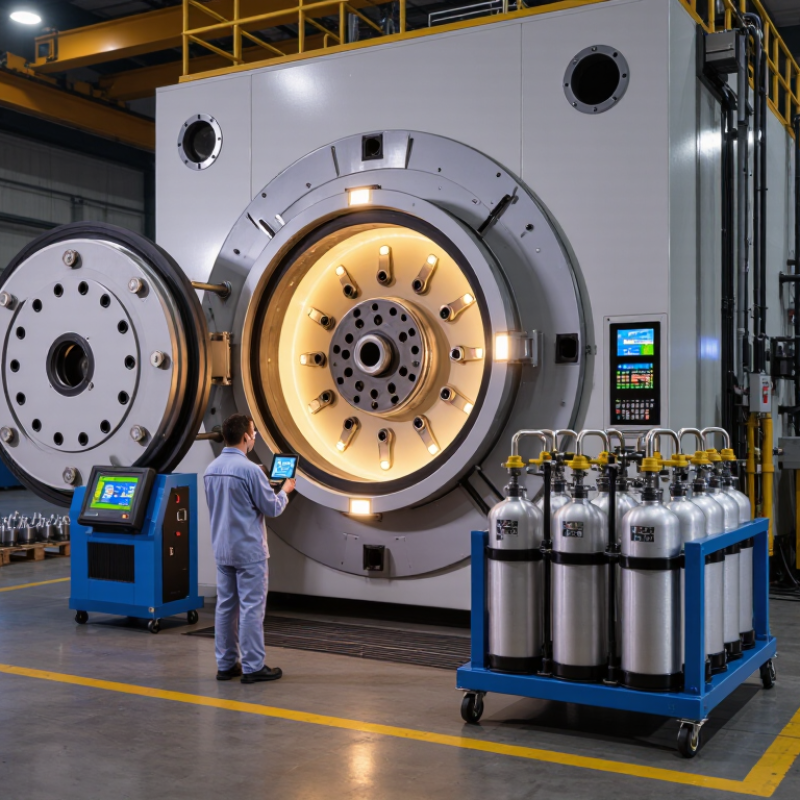
Vacuum Furnace Fundamentals: 1,200°C Temperatures and 10⁻⁵ mbar Pressure
Top Vacuum Furnace Heat Treatment Manufacturers?
A reliable vacuum furnace must control both heat and atmosphere with precision. At 1,200°C, small temperature differences can change hardness, grain structure, and dimensional stability. At 10⁻⁵ mbar, the chamber contains very little residual gas. This helps reduce oxidation, discoloration, and unwanted surface reactions during treatment.
Experienced manufacturers should provide calibrated thermocouples, stable heating zones, and recorded pressure data. Ask how the furnace performs with your actual load, not an empty chamber. A dense metal basket can heat differently from thin components. Pump-down time also matters. A slow vacuum cycle may reduce production efficiency. Proper seals, clean surfaces, and routine leak testing support dependable results. Still, published specifications are not the whole story. Real performance can vary after installation, and I would not ignore that uncomfortable detail.
Tips: Verify temperature uniformity with a qualified survey before production use. Review vacuum readings during heating, not only before heating. Keep a maintenance log for pumps, seals, sensors, and filters. Request sample reports from comparable workloads. If parts show unexpected color or hardness, check loading patterns and cooling conditions before blaming the furnace. Small mistakes often hide there.
How Manufacturers Achieve ±5°C Temperature Uniformity
Top Vacuum Furnace Heat Treatment Manufacturers?
Achieving ±5°C temperature uniformity is not a matter of adding more heating power. Experienced manufacturers begin with furnace mapping. They place calibrated thermocouples throughout the hot zone, including corners, center, and near the door. Empty-chamber tests reveal cold spots. Loaded tests show how parts change heat flow.
The control system then balances multiple heating zones. Independent sensors detect small temperature differences, while tuned PID controls adjust power gradually. Careful insulation also matters. A dense graphite hot zone reduces radiant heat loss and limits temperature drift. Vacuum quality is checked because trapped gases can affect heat transfer and surface condition. Small details count.
Load design remains a practical challenge. Thick components heat slowly, while thin parts respond quickly. Skilled engineers use fixtures that maintain spacing and prevent shadowing.
They also record ramp rates, soak times, sensor positions, and calibration results for every qualified cycle. Traceable instruments support reliable production decisions.
The target is demanding. A poorly arranged load can exceed the limit. Even a well-mapped furnace may perform differently after maintenance, insulation wear, or thermocouple replacement. That is why responsible manufacturers repeat surveys at planned intervals and investigate unusual readings instead of hiding them. Some results will be imperfect. The useful response is correction, not optimistic paperwork.
Comparing Furnace Types for Aerospace, Tool Steel, and Medical Parts
Top Vacuum Furnace Heat Treatment Manufacturers?
Comparing Furnace Types for Aerospace, Tool Steel, and Medical Parts
Choosing a vacuum furnace depends on alloy, geometry, quench demand, and documentation. Aerospace parts often require high-vacuum heating with controlled gas cooling. This reduces oxidation on titanium, nickel alloys, and precision assemblies. A 2022 U.S. Department of Energy Industrial Decarbonization Roadmap reports that process heating represents about 51% of manufacturing energy use. Efficient insulation and programmable cycles therefore matter, not just maximum temperature.
Tool steel needs a different balance. A high-pressure gas-quench furnace can harden complex dies with less distortion than oil quenching. Vacuum oil-quench systems may suit larger sections, but cleaning and maintenance become more demanding. Medical parts usually prioritize surface cleanliness, repeatability, and traceability. Vacuum sintering or annealing can protect stainless steel and titanium from discoloration. ISO 13485 emphasizes documented, controlled production, so digital recipe records should be treated as essential evidence.
Tips: Ask for uniformity-test results, quench pressure, working-zone dimensions, and oxygen-monitoring data. Request sample coupons from your actual alloy. Small differences matter. Do not select equipment from temperature rating alone. The ASM Handbook on heat treating notes that atmosphere control and cooling conditions strongly influence final properties. In practice, the “best” furnace may still fail if loading patterns are inconsistent. That is an uncomfortable detail, but it deserves attention.
Evaluating Manufacturers Through AMS2750, Nadcap, and ISO 9001
Choosing a top vacuum furnace heat treatment manufacturer requires more than checking equipment photos. AMS2750 evaluates pyrometry, temperature uniformity surveys, system accuracy tests, and calibration control. Ask for recent records, not general claims.
Nadcap accreditation adds independent process scrutiny for aerospace work. The 2023 Nadcap program report describes more than 4,000 accredited aerospace sites worldwide, showing how widely the system is used. However, accreditation scope matters. A supplier approved for vacuum brazing may not qualify for your heat treatment process. Verify the exact commodity, furnace class, and expiration date.
ISO 9001 supports broader quality management, but it does not prove thermal performance. The ISO Survey 2022 recorded 1,265,216 ISO 9001 certificates globally. That figure shows popularity, not capability. Review nonconformance trends, corrective-action speed, traceability, and subcontractor controls. One overlooked detail can damage an otherwise strong evaluation.
Tips: Request a sample pyrometry package. Check sensor identification, calibration dates, TUS mapping, and load records. Confirm data retention periods before placing production work. Speak with the quality manager, not only sales staff. Small warning signs matter. A clean certificate can still hide weak daily discipline.
Top Vacuum Furnace Heat Treatment Manufacturers? Reference Framework for Evaluation
Comparing certification and audit intervals helps buyers interpret supplier evidence. AMS2750 defines pyrometry and process-control requirements but does not impose a universal third-party certification cycle. Nadcap audits are generally annual, with longer intervals possible under merit-based accreditation. ISO 9001 certification follows a three-year cycle with periodic surveillance audits.
Reference values are framework-level guidance, not rankings or performance scores for individual manufacturers. Supplier qualification should also verify furnace class, temperature uniformity surveys, system accuracy tests, calibration traceability, process records, and corrective-action history.