

• Gantry Robot Manufacturer & Articulated Arm Integrator

Why Choose a FOC Motor Controller for Your Application?

Choosing a Foc Motor Controller can make a clear difference when an application needs smooth torque, responsive speed control, and efficient operation. Field-oriented control regulates motor current with precision, separating torque-producing and magnetic-flux components. That gives engineers finer control than basic methods often provide. The benefit is tangible: a small pump can hold a steady flow, while an electric drive can accelerate without a harsh jolt.

Motor-control researcher Peter Vas has published extensively on vector control. A fair paraphrase of the principle behind this work is: “Control magnetic flux and torque independently for more precise motor response.” This is not a verbatim quotation. It captures why field-oriented control is valued in demanding drive systems. Careful tuning still matters. Poor sensor readings, incorrect motor parameters, or rushed commissioning can undermine performance.

Consider the real operating conditions. Will the motor face frequent starts? Does it need to run quietly at low speed? How much heat can the enclosure dissipate? These details help determine whether a Foc Motor Controller is appropriate and how it should be configured. Better control is not automatic. It must be measured.

A useful evaluation compares torque response, energy use, noise, and integration effort against the application’s actual needs. No single controller suits every motor. The following sections examine the practical advantages, trade-offs, and selection factors, so readers can judge where FOC offers measurable value—and where a simpler control method may be enough.
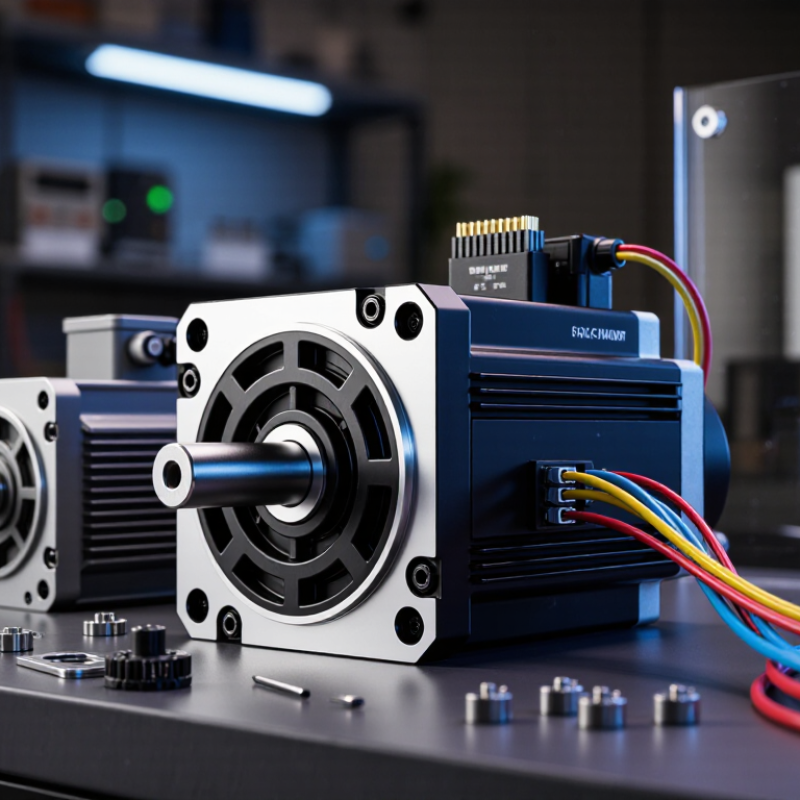
Why Choose a FOC Motor Controller for Your Application?

What Is a Field-Oriented Control Motor Controller?

A field-oriented control (FOC) motor controller manages motor current to control torque and speed smoothly. It transforms measured phase currents into two components: one that produces magnetic flux, and another that produces torque. The controller adjusts these components separately, much like tuning two related controls instead of guessing at one combined signal. That is the core idea.

To do this, it needs information about the rotor’s position, supplied by a sensor or estimated from electrical signals. Fast calculations then guide the inverter’s switching, often using pulse-width modulation. In a small robotic joint, for example, FOC can help the motor move slowly without the rough, noticeable steps common with simpler control methods. It can also improve response when a load changes. The calculations are demanding, though, and poor current measurements or an inaccurate position estimate can undermine performance.

FOC is not automatically the right choice. It may require more setup, processing power, and careful tuning than a basic controller. Noise, wiring layout, and motor parameters matter in real installations. One detail is easy to overlook: smooth operation depends on the whole drive system, not just the control algorithm. A practical evaluation should include startup behavior, low-speed torque, temperature, and the actual load.

How Does FOC Control Motor Torque and Speed?

Field-oriented control (FOC) separates motor current into two components: one that builds magnetic flux and another that produces torque. A controller transforms measured phase currents into rotating d-q coordinates, then adjusts inverter output to track the requested currents. For many permanent-magnet motors, torque closely follows q-axis current. On a surface-mounted design, the d-axis reference is often near zero; other motor types may need a different setting.

A speed loop compares the target speed with feedback from an encoder or sensorless estimator. It turns the speed error into a torque request, which sets the q-axis current target. The inner current loops respond faster, helping the motor hold speed when a conveyor load changes or a wheel meets a slope.

The U.S. Department of Energy’s 2014 Sourcebook for Industry reports that motor-driven systems account for roughly 70% of electricity use in U.S. industrial facilities. That figure describes energy use, not a guaranteed saving from FOC.

The key is feedback. Poor tuning, noisy current readings, or a weak low-speed estimate can still cause ripple and sluggish response. FOC can deliver smooth torque, but it is not magic; motor parameters and control-loop tuning matter. A practical test is to log current and speed during a sudden load change, then check whether torque settles without overshoot.

What Performance Benefits Can an FOC Controller Provide?

A field-oriented control (FOC) motor controller manages current in relation to the motor’s magnetic field. This precise approach can produce smoother torque than simpler control methods, especially when speed changes often. By reducing torque ripple, it can also limit vibration and audible motor noise. That matters in a small fan, where a rough start may be easy to hear.

At low speeds, FOC can maintain more consistent motion and respond accurately to changing loads. In a pump, for example, flow may shift as valves open or close. A well-tuned controller can adjust motor torque without abrupt speed swings. Less vibration. In practice, the result depends on the motor, sensors, and control settings; FOC is not an automatic fix for mechanical imbalance.

Efficient current control may reduce electrical losses and motor heating under suitable operating conditions. That can support longer operation, though the actual benefit varies with load and system design. FOC can also provide responsive speed control, but setup takes care: incorrect motor data or tuning may cause instability rather than smoother operation. For an application with frequent starts, quiet running, or precise low-speed motion, these performance gains may justify the added control complexity.

Why Choose a FOC Motor Controller for Your Application? - What Performance Benefits Can an FOC Controller Provide?

Performance Dimension FOC Controller Characteristic Potential Application Benefit Important Consideration
Torque Smoothness Regulates motor current in a rotating reference frame, typically controlling torque-producing current separately from flux-producing current. Can reduce torque pulsation and improve smoothness compared with basic six-step commutation, particularly at low speeds. Results depend on motor design, current sensing, tuning, and the quality of rotor-position estimation.
Low-Speed Operation Uses coordinated phase-current control and rotor-position information or an estimate of rotor position. Can provide controlled, stable torque at low speed, which is useful for positioning and smooth starts. Sensorless position estimation is more challenging near zero speed; a position sensor or a suitable startup method may be needed.
Acoustic Noise and Vibration Smoothly adjusts the motor's phase currents rather than relying only on discrete commutation steps. May reduce electromagnetic torque variation and associated noise or vibration. PWM switching, mechanical resonance, and motor construction can still produce audible noise.
Dynamic Torque Response A current-control loop can adjust torque-producing current directly, subject to the controller's limits and tuning. Can support responsive changes in commanded torque for acceleration, load changes, and motion control. Response is limited by motor inductance, available voltage, current limits, sampling rate, and control-loop bandwidth.
Efficiency and Heating Enables precise current regulation and, in suitable motor systems, operation with reduced unnecessary current. May improve energy use and reduce winding losses in parts of the operating range when compared with less optimized control. Efficiency is application-dependent; motor selection, load, speed, switching losses, and tuning all matter.
High-Speed Operation Can use field-weakening control to reduce effective flux when the motor approaches its voltage limit. Can extend the usable speed range above the motor's base speed in appropriately designed systems. Field weakening reduces available torque and requires suitable motor, inverter, and protection limits.
Regenerative Operation A bidirectional motor drive can control current during braking and return energy to a compatible DC bus. Can enable controlled regenerative braking in applications designed to accept returned energy. FOC alone does not guarantee energy recovery; the inverter, power source, and DC-bus system must support it.
Control Complexity Typically requires coordinate transforms, current sensing, rotor-position information or estimation, and control-loop tuning. Provides fine-grained control suited to applications that value smooth torque and precise speed or position behavior. Compared with simpler control methods, setup, computation, sensing, and validation requirements may be greater.

Note: Benefits are typical possibilities, not guaranteed performance figures. Actual results depend on the motor, inverter, sensing method, control tuning, operating conditions, and application requirements.

Which Motors and Applications Are Best Suited to FOC?

Field-oriented control (FOC) is especially useful when a motor needs smooth torque across a wide speed range. It suits permanent-magnet synchronous motors and brushless DC motors, and can also control induction motors with suitable tuning. In practice, that makes it a strong option for robotic joints, CNC axes, variable-speed pumps, and electric traction. Smooth at low speed.

The U.S. Department of Energy’s motor-systems sourcebook reports that motor systems use about 70% of industrial electricity. The International Energy Agency has estimated their share at roughly 46% of global electricity use. These figures do not mean FOC alone delivers those savings. They show why precise motor control matters: in pumps and fans, adjusting speed to match demand can avoid needless throttling and reduce energy use.

FOC is most compelling where quiet operation, accurate speed, or responsive torque matters. A conveyor that starts under load, for example, benefits from controlled torque rather than a sharp jolt. But the drive needs correct motor parameters, and sensorless control may struggle at very low speeds or standstill. That trade-off is easy to underestimate. For simple, fixed-speed equipment, a less complex controller may be the more practical choice.

Why Choose a FOC Motor Controller?

Field-oriented control (FOC) is well suited to permanent-magnet synchronous motors (PMSM, including many motors marketed as BLDC) and induction motors when smooth torque, precise speed control, or strong low-speed performance is needed.

Idealized three-phase FOC current references: the normalized phase currents are balanced sinusoids separated by 120 electrical degrees. This is a theoretical waveform, not measured motor data. FOC is commonly used in applications such as robotics, electric traction, and variable-speed pumps or fans; the best choice depends on torque, speed, efficiency, and controller-complexity requirements.

What Factors Matter When Selecting an FOC Controller?

Selecting a field-oriented control (FOC) motor controller starts with the motor and its real operating demands. Check the motor’s rated voltage, continuous and peak phase current, speed range, and torque requirements. A controller that meets a brief peak-current target may still overheat during sustained operation. Heat matters. Review cooling, enclosure space, and expected ambient temperature together, not as separate details.

Feedback compatibility is another key factor. Confirm whether the motor uses Hall sensors, an encoder, a resolver, or sensorless operation, and check that the controller supports the required interface. Then consider startup behavior, low-speed torque, speed response, and available tuning tools. Sensorless control can simplify wiring, but may perform differently under heavy loads at very low speeds. Bench testing is useful here; specification sheets rarely describe every startup quirk.

Also examine protection and integration features. Useful safeguards include overcurrent, overvoltage, undervoltage, and thermal protection, along with clear fault reporting. Check communication options, control inputs, regenerative-braking needs, and how the unit fits your power supply. Test it. A careful trial should use the actual motor, load, and wiring where possible. One easy-to-miss detail is cable length: longer leads can affect electrical behavior, so validate the complete setup rather than the controller alone.