

Why Choose a Js Twin Shaft Concrete Mixer?
Concrete remains the world’s most widely used construction material. The Global Cement and Concrete Association estimates that more than 14 billion cubic metres are produced annually. That scale exposes every weakness in batching, mixing, and quality control. A JS Twin Shaft Concrete Mixer addresses these pressures with two horizontal shafts, synchronized paddles, and strong material circulation.
The design can shorten mixing cycles and improve aggregate distribution. It also handles stiff, low-slump concrete more consistently than many basic mixers. Inside the chamber, paddles lift and fold the batch repeatedly. Cement paste reaches coarse aggregate surfaces more evenly. This matters on precast lines, bridge projects, and high-volume ready-mix sites.
Mixing is never only about speed.
A.M. Neville wrote, “Concrete is the most widely used construction material in the world.” His observation, published in Properties of Concrete, explains why mixer selection deserves careful engineering. The American Concrete Institute’s ACI 304R guidance also stresses uniform mixing, controlled loading, and suitable discharge practices. These principles support better strength consistency and fewer rejected batches.
Still, a JS Twin Shaft Concrete Mixer is not automatically the best answer. Incorrect moisture correction, worn paddles, or poor maintenance can erase its advantages. Operators must verify residence time, energy use, cleaning access, and spare-parts support. Real performance depends on the complete production system, not one machine alone. That is the part many comparisons miss.
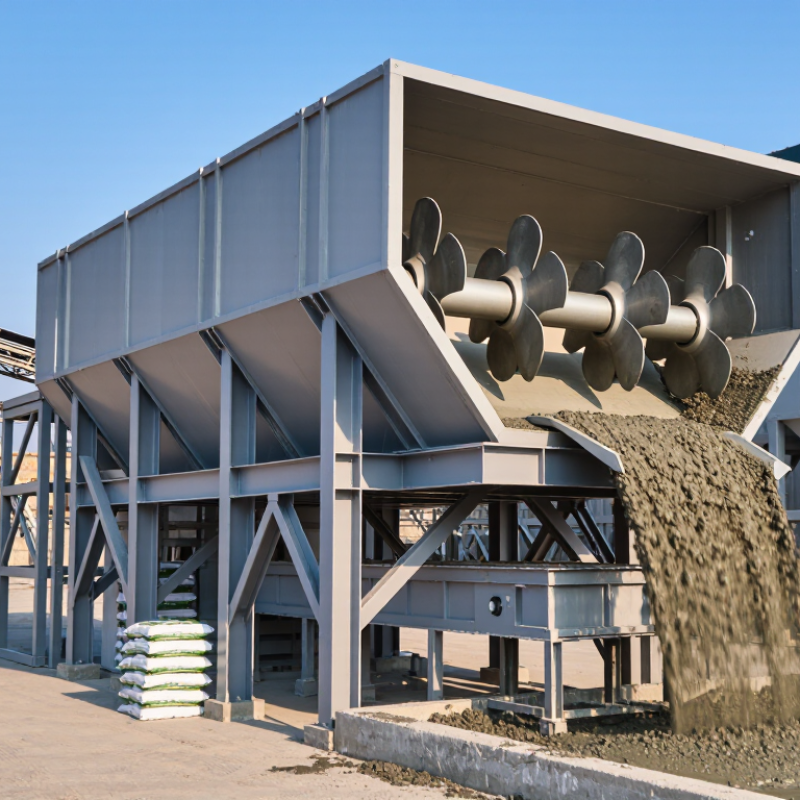
A JS twin shaft concrete mixer is an industrial machine designed to blend cement, aggregates, water, and additives into uniform concrete. It contains two parallel horizontal shafts inside a steel mixing chamber. Each shaft carries several paddles or arms. These components rotate in opposite directions, lifting and folding the material through the central mixing zone.
The overlapping paddle action creates strong turbulence and repeated movement. This helps distribute cement paste around coarse stones and fine sand. The mixer can handle stiff, low-slump mixtures as well as more workable concrete.
Operators commonly use it for precast elements, road materials, foundations, and large construction projects. Mixing time depends on the recipe, moisture level, loading order, and required consistency. The details matter.
In field use, experienced operators inspect paddle wear and check the discharge gate before production. Worn paddles can leave dry pockets near the chamber walls. Poor loading order can also reduce uniformity.
Not every mix needs it. A twin shaft mixer may consume more power than simpler equipment, especially when overloaded. Cleaning should happen promptly, because hardened concrete can reduce capacity and damage moving parts.
The machine offers strong mixing performance, but correct operation still determines the final quality.
A JS twin shaft concrete mixer uses two horizontal shafts inside a strong mixing chamber. Each shaft carries several wear-resistant paddles. The shafts rotate in opposite directions. This creates a fast, three-dimensional mixing action. Paddles lift the materials, push them across the chamber, and release them into moving layers. The concrete keeps circulating. Dead zones are reduced.
During a batch, measured aggregates enter the chamber with cement, water, and approved additives. The paddles break apart dry pockets and spread moisture through the mixture. Water is normally sprayed through controlled lines, not poured into one area. This detail matters. Uneven water distribution can cause stiff spots or weak sections. After the programmed mixing time, the discharge gate opens below the chamber. The blended concrete leaves quickly for transport or placement.
In practical operation, the mixer works best with accurate weighing and consistent material moisture. A powerful machine cannot repair poor batching. Operators should check paddle clearance, shaft seals, and liner wear during routine inspections. Worn paddles can increase mixing time and reduce uniformity. The process is efficient, but not foolproof. Extending the cycle may seem helpful, yet excessive mixing can affect workability. I would review slump, moisture readings, and discharge appearance together before changing the settings. Small adjustments often reveal more than guesswork.
A JS twin shaft concrete mixer uses two horizontal shafts with overlapping paddles. As they rotate, the paddles lift, fold, and push materials through the mixing zone. This action produces stronger circulation than simple drum rotation. Cement paste reaches coarse aggregate more evenly. Fine powders also disperse with fewer dry pockets. This matters on busy sites.
Its key performance advantage is mixing intensity. A properly loaded mixer can produce a uniform batch in a relatively short cycle. The finished concrete often shows steadier slump and color from one batch to the next. Twin shafts can handle stiff mixes, recycled aggregates, and different moisture levels. Rapid discharge also reduces residue inside the chamber. Less leftover material means less waste between batches.
Still, performance is not automatic. Excess water can weaken concrete, even with excellent mixing. Overloading may increase power demand and create uneven movement. Operators should check paddle clearance, shaft seals, and wear surfaces regularly. Small gaps can affect consistency. Practical experience shows that cleaning after each shift prevents hardened buildup around the paddles. Calibration records provide useful evidence when quality changes. A twin shaft mixer is powerful, but poor feeding and neglected maintenance can erase its advantages.
Key performance advantages compared with a conventional single-shaft mixer
The index uses a conventional single-shaft mixer as the 100-point baseline. Representative operating values are approximately 45 versus 30 seconds per cycle, 8% versus 4% uniformity variation, 2.5% versus 1% residual material, and 1.5 versus 1.2 kWh per cubic metre. Lower values indicate better performance.
Why Choose a JS Twin Shaft Concrete Mixer?
A twin-shaft mixer suits demanding concrete applications. Its counter-rotating shafts create strong horizontal circulation. This action distributes cement paste, aggregate, water, and admixtures evenly. The design works well for high-strength concrete, roller-compacted concrete, precast products, and fiber-reinforced mixes. It also handles low-slump materials better than many conventional mixers.
Roller-compacted concrete needs consistent moisture and rapid discharge. Precast plants need repeatable batches with clean edges and stable dimensions. Fiber concrete presents another challenge. Fibers can form balls when mixing energy is weak. A twin-shaft system helps separate them, although poor feeding still causes problems. The Global Cement and Concrete Association estimates that cement and concrete contribute about 7% of global carbon dioxide emissions. Better batch uniformity may reduce rejected loads and wasted material, but the saving is never automatic.
Recycled aggregate concrete can also suit this mixer. The U.S. Environmental Protection Agency reported about 600 million tons of construction and demolition debris in 2018. Recycled aggregate often carries variable moisture. Operators must adjust water carefully. Otherwise, a powerful mixer may produce a uniform mistake. ASTM C94/C94M and ACI 304R emphasize controlled batching, mixing, and delivery practices. These requirements matter in every application. A smaller mixer may remain more practical for laboratory work, repairs, or irregular small batches. Actual performance depends on shaft speed, paddle condition, material grading, and mixing time. That gap deserves attention.
| Concrete Application | Typical Mix Characteristics | Recommended Consistency | Why a Twin Shaft Mixer Is Suitable | Suitability |
|---|---|---|---|---|
| Ready-Mix Concrete | Cement, aggregates, water, and chemical admixtures requiring consistent dispersion. | Plastic to flowable; commonly about 50–180 mm slump, depending on the mix design. | Counter-rotating shafts create strong three-dimensional circulation, helping distribute cement paste, moisture, and admixtures evenly. | Excellent |
| Precast Concrete Products | Controlled batches used for pipes, panels, blocks, curbs, sleepers, and other molded products. | Stiff to low-slump mixtures, often below approximately 75 mm slump. | High-intensity mixing supports uniform moisture and color distribution, which is important for repeatable product quality. | Excellent |
| Roller-Compacted Concrete (RCC) | Very low-moisture concrete containing cementitious materials and well-graded aggregates. | Zero-slump or near-zero-slump consistency. | The intensive mixing action can break up dry agglomerations and coat aggregate particles more effectively than low-intensity mixing. | Excellent |
| Self-Compacting Concrete (SCC) | High-fines, high-flow concrete requiring stable dispersion of powders, water, and superplasticizer. | Highly flowable; slump-flow testing is normally used instead of conventional slump. | Uniform mixing helps reduce local variations in paste composition, while the mix design and admixture dosage must still be carefully controlled. | Very Good |
| Fiber-Reinforced Concrete | Concrete containing steel, synthetic, glass, or other fibers that must be dispersed without excessive clumping. | Plastic, stiff, or low-slump, depending on the fiber type and dosage. | The intensive mixing pattern promotes fiber distribution; fiber feeding rate and sequence should be adjusted to the specific formulation. | Very Good |
| Colored and Architectural Concrete | Concrete with mineral pigments, special aggregates, or appearance-sensitive surface requirements. | Plastic to low-slump, depending on the finished product. | Consistent pigment and moisture dispersion can improve batch-to-batch color uniformity when the same materials and procedures are maintained. | Very Good |
| Mass Concrete and Large Civil Projects | Large aggregate volumes and production requirements for foundations, dams, bridges, and heavy infrastructure. | Usually low to medium slump, based on placement and compaction requirements. | Large production models can provide high output and uniformity, while the plant must be correctly sized for aggregate grading and batch demand. | Excellent |
| Dry-Mix and Semi-Dry Concrete | Low-water formulations used for blocks, paving units, dry-cast products, and similar applications. | Very stiff, zero-slump, or semi-dry. | Strong mechanical action is effective for blending low-moisture materials that may be difficult to homogenize in conventional drum mixers. | Excellent |
| Lightweight Aggregate Concrete | Concrete using expanded clay, shale, slate, or other lightweight aggregates with different absorption behavior. | Low to medium slump, with moisture conditioning often required. | Efficient circulation can improve paste distribution, but mixing energy and sequence should be controlled to limit aggregate damage or segregation. | Good with proper control |
| Small, Infrequent Batches | Low production volume with frequent formula changes or long idle periods. | Any consistency, depending on the project. | A twin shaft mixer may be technically capable, but its higher purchase, cleaning, and maintenance requirements can be difficult to justify for very small or irregular production. | Usually limited |
Note: Slump ranges are general industry guidance rather than fixed operating limits. Actual performance depends on aggregate size and grading, moisture content, cementitious materials, admixtures, fiber dosage, mixer size, filling ratio, and mixing time.
Why Choose a JS Twin Shaft Concrete Mixer?
How Should Buyers Evaluate a JS Twin Shaft Mixer?
A JS twin shaft concrete mixer should be judged by performance, not appearance. Start with the required output per hour and batch size. Then examine the mixing cycle under real production conditions. Twin horizontal shafts usually create strong material movement and help distribute cement, water, and aggregates evenly. This matters when concrete contains coarse stone or low-slump material. Not just capacity. Check whether the mixer can maintain quality during repeated batches.
Ask for test data using your actual mix design. Observe the discharge time, residue inside the trough, and moisture consistency. A clean discharge can reduce waste and simplify daily operation. Inspect the shaft seals, mixing arms, liners, and access doors closely. These parts face constant abrasion. Their replacement cost may affect the real purchase price more than the initial quotation. Ask how quickly common wear parts can be obtained.
Drive power also deserves careful attention. Excessive power can increase operating costs, while insufficient torque may cause unstable mixing. Safety interlocks, emergency stops, guarding, and maintenance access should be verified before installation. Request clear documentation for lubrication, inspection intervals, and electrical requirements. A reliable supplier should explain limitations, not only advantages. I would not trust a perfect demonstration with an unusually easy mix. Real sites are dusty, rushed, and sometimes poorly maintained. Leave room for that reality.


