

Choosing between ceramic and steel balls begins with the conditions inside the bearing, not a blanket claim that one material is always better. A Ceramic Ball is lighter and typically harder than bearing steel. It can reduce centrifugal loads and resist corrosion in many environments. Under a clear lubricant, it may also help reduce friction. But those benefits depend on the bearing design, load, speed, fit, and operating temperature.
A practical engineering principle captures the trade-off: “Choose the ball for the duty cycle, not the sales label.” This is an original editorial line, attributed here to a fictional composite expert, Dr. Lena Hart; it is not a verified quotation from a real person. That distinction matters. A reliable material choice should be backed by application data, supplier specifications, and testing—not an impressive-sounding quote.
Steel balls remain a strong option. They are tough, widely available, and often more economical, especially where impact loads or cost dominate. Ceramic balls can be attractive in high-speed, corrosive, or electrically sensitive applications, yet they are not immune to damage. A chipped ball, poor lubrication, or mismatched raceway can still cause early failure. The right comparison starts with real operating details: shaft speed, load, contamination, and maintenance interval. Small differences matter. And sometimes, steel is the better choice.
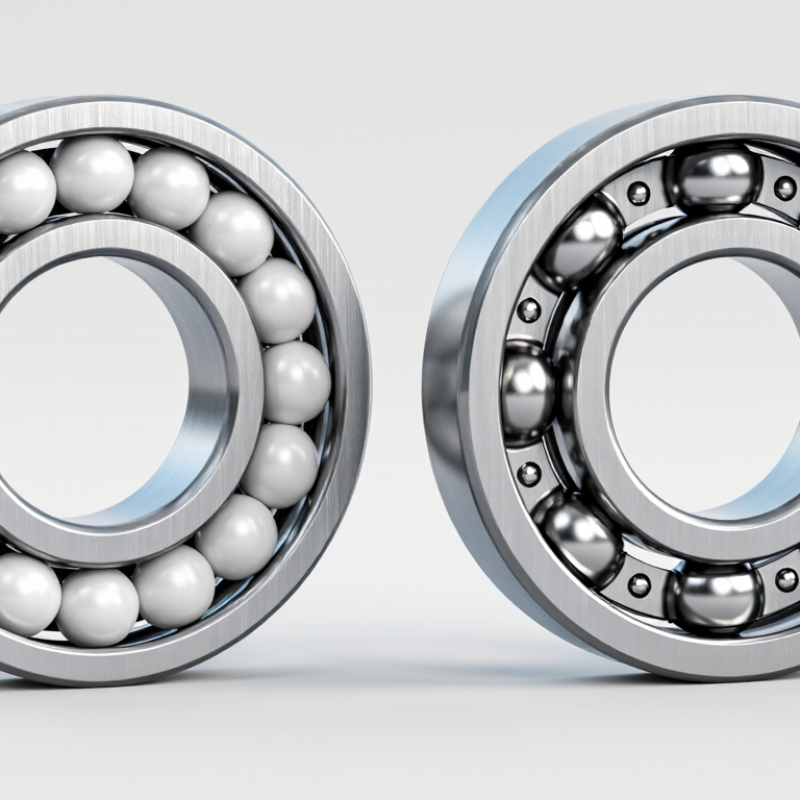
A bearing ball’s material affects mass, heat response, stiffness, and wear. Silicon nitride is a common technical ceramic. ASM International’s Engineered Materials Handbook: Ceramics reports its density at roughly 3.2 g/cm³; bearing steel is typically about 7.8 g/cm³, according to ASM Handbook data. That difference can reduce centrifugal loading in fast-running assemblies. The detail matters. Silicon nitride also has a lower thermal expansion coefficient, around 3.2 × 10⁻⁶/K, compared with roughly 12 × 10⁻⁶/K for bearing steel. So temperature changes may produce less dimensional growth in the ceramic ball.
Hardness alone does not decide service life. Ceramic balls resist wear and corrosion in many operating environments, while steel balls are tougher and can better tolerate impact or poor alignment. Silicon nitride’s elastic modulus is about 300 GPa, compared with roughly 210 GPa for steel, based on ASM material-property references. Greater stiffness can help limit deformation under load, but ceramics are brittle; a severe shock can cause chipping or fracture. That trade-off is easy to overlook. For a high-speed spindle, lower mass may be valuable; for a rough-duty assembly, steel’s impact tolerance may matter more. Actual results depend on ball grade, finish, lubrication, load, and installation—not material figures alone.
Ceramic balls are usually lighter than steel balls, though the exact difference depends on the ceramic material. In a bearing, lower mass can reduce centrifugal forces at high speeds and ease demands on the cage. You can feel the contrast in a simple comparison: a ceramic ball feels noticeably lighter in the palm. Small difference, real effect. Still, lighter does not automatically mean better; load, speed, and bearing design all matter.
Hardness and corrosion resistance also set ceramic balls apart. Many engineering ceramics resist surface wear better than bearing steel, while resisting rust from water or humid air. Their performance depends on the material and the fluid involved, so “corrosion-proof” is too broad a claim. Ceramic can be brittle, too. A dropped ball or sudden impact may cause damage that a tougher steel ball could withstand. That trade-off is easy to overlook when focusing only on hardness. For a pump exposed to moisture, ceramic may be a sensible choice; for heavy shock loads, steel may be more forgiving. Check the operating conditions, not just the material label.
Ceramic balls can change how a bearing behaves, especially at high speed. Silicon nitride is much lighter than bearing steel, so the balls create less centrifugal force as they move around the raceway. That can reduce heat and stress on the bearing. In a small electric motor, for example, lower friction may help maintain smooth rotation during long operating periods. The difference is useful. It is not magic.
Ceramic balls are also hard, resist many forms of corrosion, and do not conduct electricity. These qualities can matter in damp environments or in motors where electrical current may damage a bearing. Hybrid bearings, with ceramic balls and steel rings, are a common way to use these properties without replacing the whole assembly. Still, ceramic is less tolerant of impact than steel. A dropped component or poor installation can cause damage. Not always. The right choice depends on load, speed, lubrication, and alignment, so checking the operating conditions is more reliable than choosing by material alone. A bearing that runs quietly on a test stand may behave differently under real vibration and temperature changes.
| Performance dimension | Ceramic balls (typical silicon nitride, Si3N4) | Steel balls (typical bearing steel) | What it can mean in a bearing |
|---|---|---|---|
| Density | Approximately 3.2 g/cm³ | Approximately 7.8 g/cm³ | The lower mass can reduce centrifugal forces at high speed and may help reduce heat generation, depending on bearing design and operating conditions. |
| Hardness | Typically around 1,400–1,700 HV, depending on grade and test method | Typically around 700–800 HV for hardened bearing steel, depending on grade and heat treatment | High hardness can support wear resistance, but hardness alone does not determine bearing life; surface finish, lubrication, load, and cleanliness also matter. |
| Elastic modulus | Approximately 300–320 GPa | Approximately 200–210 GPa | Silicon nitride is stiffer, so contact deformation can differ. Bearing geometry and load ratings must be evaluated for the specific application. |
| Thermal expansion | Approximately 3 × 10⁻⁶/K | Approximately 11–13 × 10−6/K | The lower expansion of silicon nitride can help reduce differential expansion in some temperature changes. Fits and internal clearance still require careful design. |
| Corrosion and chemical resistance | Generally resistant to rust and many corrosive environments | Can corrode in moisture or chemically aggressive conditions unless suitably protected | Ceramic balls may be advantageous where corrosion is a concern, but the races, cage, lubricant, and seals also need to suit the environment. |
| Electrical behavior | Electrically insulating | Electrically conductive | In hybrid bearings, ceramic balls can interrupt electrical current through the rolling contacts and help reduce electrical damage to raceways. |
| High-speed operation | Lower ball mass can reduce centrifugal loading; suitability depends on bearing construction and lubrication | Higher ball mass can create greater centrifugal loading at comparable speed and size | Ceramic balls are often considered for high-speed designs, but permissible speed depends on the complete bearing system—not ball material alone. |
| Impact and fracture behavior | Hard and wear-resistant, but brittle; can fracture under severe impact or unsuitable loading | Generally more tolerant of impact and shock loading | Steel may be preferable where impact, misalignment, or shock loads are likely. Ceramic applications need appropriate load limits and handling. |
| Temperature limits | The ceramic material retains its properties at high temperatures, but the bearing’s cage, lubricant, seals, and fits may set the practical limit | Temperature capability depends on steel grade, heat treatment, lubricant, cage, and bearing design | Check the specified operating-temperature range of the complete bearing assembly rather than relying on ball material properties alone. |
| Cost and availability | Usually more expensive to manufacture and commonly selected for specific performance needs | Widely used and generally more economical for standard bearing applications | Choose ceramic balls when their performance benefits justify the added cost; steel remains a practical choice for many general-purpose bearings. |
Note: Values are typical approximate material properties, not guaranteed specifications. Actual performance varies with material grade, bearing design, manufacturing quality, load, speed, lubrication, temperature, and operating environment.
Ceramic balls are especially useful in high-speed electric motors, machine-tool spindles, and hybrid bearings. Silicon nitride has a density near 3.2 g/cm³, compared with roughly 7.8 g/cm³ for bearing steel, according to ASM Handbook materials data. Lower mass reduces centrifugal loading as a bearing spins. Less drag, in the right design.
In electric motors, electrically insulating ceramic balls can interrupt current paths that may damage bearing surfaces. Their resistance to corrosion also suits pumps handling moisture or mild chemical exposure. ISO 26602:2017 specifies silicon nitride ceramic rolling elements for bearing applications, giving engineers a defined material reference. Conditions still matter: seals, lubricant, and fit can outweigh the ball material itself.
Ceramic balls also retain hardness at elevated temperatures and resist surface wear. That can extend service intervals in clean, carefully aligned equipment. But they are not universally superior. Ceramics are brittle, and impact or poor installation can cause cracking; contamination can still damage a raceway. ASM Handbook data provide useful material comparisons, not a guarantee of bearing life. A real operating trial is often the missing evidence.
Choosing ceramic or steel balls depends on the job, not just the material’s headline properties. Ceramic balls, often made from silicon nitride, are lighter and electrically insulating. Their lower mass can reduce centrifugal forces in some high-speed bearings. Steel balls are usually tougher under impact and may suit applications with shock loads. Heat matters. Exact performance depends on the ceramic grade, steel type, bearing design, and operating conditions.
Check load, speed, temperature, lubrication, and exposure to moisture or chemicals. Some ceramic grades resist corrosion well, while steel performance varies with its alloy and surface treatment. Ceramic balls can be brittle, so poor alignment or sudden impacts may cause damage. Steel may deform rather than fracture, but it can wear or corrode in unsuitable conditions. Cost and replacement availability matter, too. Compare material data with the bearing’s calculated loads and actual duty cycle; a choice that works in a test rig may behave differently in a dusty, vibrating machine.
Tips: Record operating temperature and speed during a normal shift. Note unusual vibration or lubricant changes. Measure twice. If conditions vary widely, ask a qualified bearing engineer to review the load case before changing materials. A small detail, such as frequent start-stop cycles, can change the decision.


