


What Is the Best Pick and Place Automation in China?
Choosing the best pick and place automation in China requires more than comparing catalog prices or advertised cycle times. The right system must match product size, weight, surface condition, layout, and production volume. A robot moving lightweight cartons needs different tooling from a machine handling glass components or delicate electronic parts. Small details matter, including gripper pressure, conveyor accuracy, sensor response, and access to replacement parts.
China offers a broad industrial ecosystem, from established automation manufacturers to specialized system integrators. Some suppliers provide robots, vision systems, conveyors, safety equipment, programming, and commissioning as one package. Others focus on a single component and depend on partners for integration. This difference can affect installation quality and long-term support. A practical evaluation should include factory references, documented testing, maintenance procedures, software compatibility, and operator training.
The “best” solution is rarely the most powerful one. It is the system that delivers stable performance under real working conditions. That means checking cycle time with actual products, not demonstration samples. It also means observing the machine after several hours of operation, when heat, dust, vibration, or product variation may reveal weaknesses. Some supplier claims remain difficult to verify without an on-site trial. That is an important limitation. A careful buyer should compare measurable results, total ownership costs, safety compliance, and service responsiveness before making a decision. This guide examines those factors and explains how to identify reliable pick and place automation for different Chinese manufacturing environments.
What Is Pick and Place Automation in China?
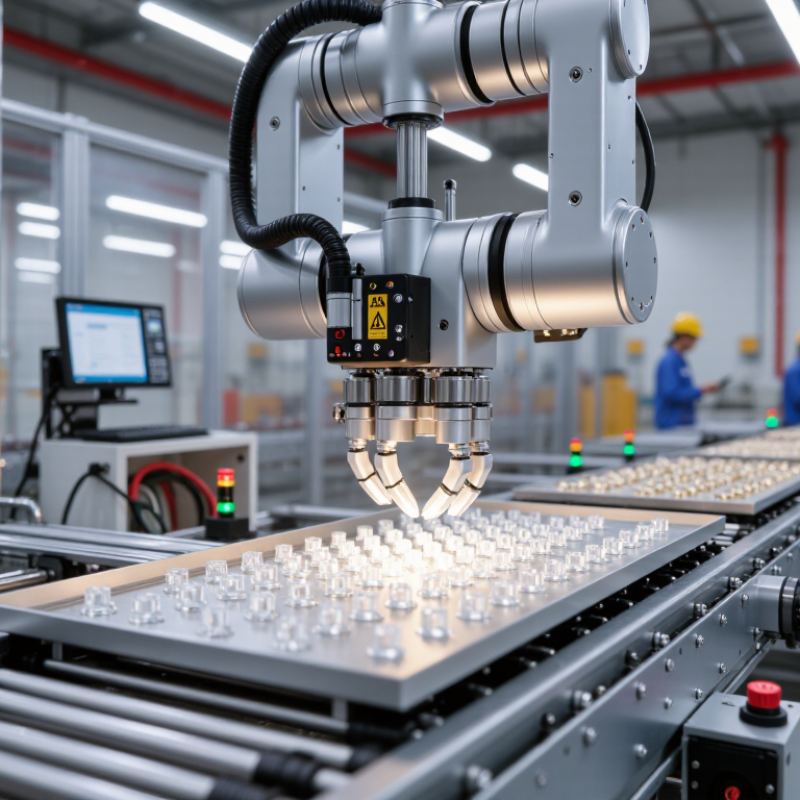
Pick and place automation in China refers to systems that move parts from one location to another with controlled speed and accuracy. A typical cell includes a robot, feeder, conveyor, gripper, vision camera, and programmable controller. These components work together to identify, lift, rotate, and position items inside a production line.
In Chinese factories, this automation is used for electronics, packaging, medical equipment, automotive parts, and household products. A camera can check orientation before the gripper collects a component. The robot then places it into a tray, fixture, or assembly station. Servo motors support precise movement, while pneumatic tools can handle simple and repetitive tasks. The correct solution depends on product weight, shape, cycle time, surface condition, and required accuracy.
Details matter greatly. During a factory evaluation, engineers should measure real cycle times, not rely only on simulations. They should also inspect changeover procedures, guarding, emergency stops, maintenance access, and spare-part availability. A well-designed system records alarms and production data for later analysis. However, automation is not always the best answer. Small product variations can confuse vision systems, and poor feeding design may stop the entire line. Early testing often reveals these weaknesses. That is useful, although some projects begin too late. Reliable suppliers should provide documented testing, operator training, and clear acceptance criteria before delivery.
What Is the Best Pick and Place Automation in China? - What Is Pick and Place Automation in China?
| Automation Type | Typical Payload | Typical Reach | Typical Cycle Performance | Best-Fit Applications | Main Advantages | Key Limitations |
|---|---|---|---|---|---|---|
| Delta Robot | 0.5–15 kg | 400–1,600 mm working diameter | Up to approximately 100–200 picks per minute, depending on payload and travel distance | Food, pharmaceuticals, consumer goods, sorting, and high-speed packaging | Very high speed, low moving mass, and excellent repeatability | Limited payload and orientation flexibility; requires a suitable overhead structure |
| SCARA Robot | 1–20 kg | 400–1,000 mm | Approximately 30–100 cycles per minute in common pick-and-place operations | Electronics, small-part assembly, loading, labeling, and packaging | Fast horizontal motion, compact footprint, and strong positional repeatability | Restricted vertical workspace and fewer orientation options than a six-axis robot |
| Six-Axis Industrial Robot | 3–250 kg | 500–3,500 mm | Approximately 8–40 cycles per minute, depending on payload, reach, and motion path | Automotive components, machine tending, palletizing, welding, and complex transfers | Six degrees of freedom, broad workspace, and flexible tool orientation | Higher cost, larger safety area, and more complex programming than simpler robot types |
| Collaborative Robot | 3–30 kg | 500–1,800 mm | Approximately 5–25 cycles per minute in collaborative operating conditions | Small-batch production, inspection, light assembly, kitting, and machine tending | Flexible deployment, relatively simple setup, and easier production-line changeover | Lower speed and payload than many industrial robots; safety validation remains necessary |
| Cartesian Robot | 5–500 kg | Axis travel commonly 300–3,000 mm | Approximately 10–60 cycles per minute, depending on axis travel and load | Injection molding, CNC loading, pallet transfer, and linear material handling | Simple linear kinematics, high rigidity, and convenient customization for rectangular workspaces | Requires more dedicated mechanical space and has limited access to irregular work areas |
| Vision-Guided Pick and Place Cell | Determined by the selected robot and gripper | Determined by camera field of view and robot reach | Often 20–120 picks per minute, depending on recognition, conveyor speed, and product mix | Mixed-product sorting, randomly oriented parts, defect separation, and flexible feeding | Handles variable positions, improves sorting flexibility, and reduces manual inspection effort | Performance depends on lighting, product contrast, camera calibration, and software integration |
Related Posts
-
How to Choose Pick and Place Automation?
-

Top 10 Benefits of Using Industrial Robot Arms in Modern Manufacturing
-
How to Optimize Pick and Place Automation for Cost Efficiency?
-
7 Tips for Choosing the Best Pick and Place Robot
-

2026 How to Choose the Best Industrial Robot Arm for Your Business?
-
How to Optimize ASRS Systems for Maximum Efficiency and Reliability?