What Is the Best Robot Arm for Industrial Automation?
Choosing the best robot arm for industrial automation is not a simple brand comparison. The right choice depends on payload, reach, repeatability, cycle time, workspace, and integration requirements. A six-axis arm may suit complex assembly, while a compact SCARA robot may deliver faster performance for small-part handling. The factory floor decides.
Joseph Engelberger, widely regarded as the father of industrial robotics, said, “I can’t define a robot, but I know one when I see one.” His observation remains useful because robot arm performance cannot be judged from specifications alone. A machine that looks powerful on paper may struggle with vibration, limited access, poor gripper design, or inconsistent material placement.
Real conditions matter.
This guide examines robot arm options through practical engineering experience and documented manufacturer specifications. It considers payload capacity, reach, positioning accuracy, operating speed, controller compatibility, safety functions, environmental protection, maintenance, and total ownership cost. It also addresses how operators teach tasks, change tooling, and recover from faults during a busy shift.
A packaging line may need speed more than extreme precision. A welding cell may require stiffness, heat resistance, and reliable cable routing. A cleanroom application demands different protection entirely. There is no universal winner.
Even experienced engineers can choose poorly when they overlook installation space or future production changes. That weakness deserves attention. The best robot arm is not always the newest, strongest, or most affordable model. It is the system that performs reliably, integrates safely, and remains practical for the people who operate and maintain it.
Map the Industrial Robot Market: IFR Recorded 541,302 Installations in 2023
Choosing the best robot arm begins with the production task, not the largest payload.
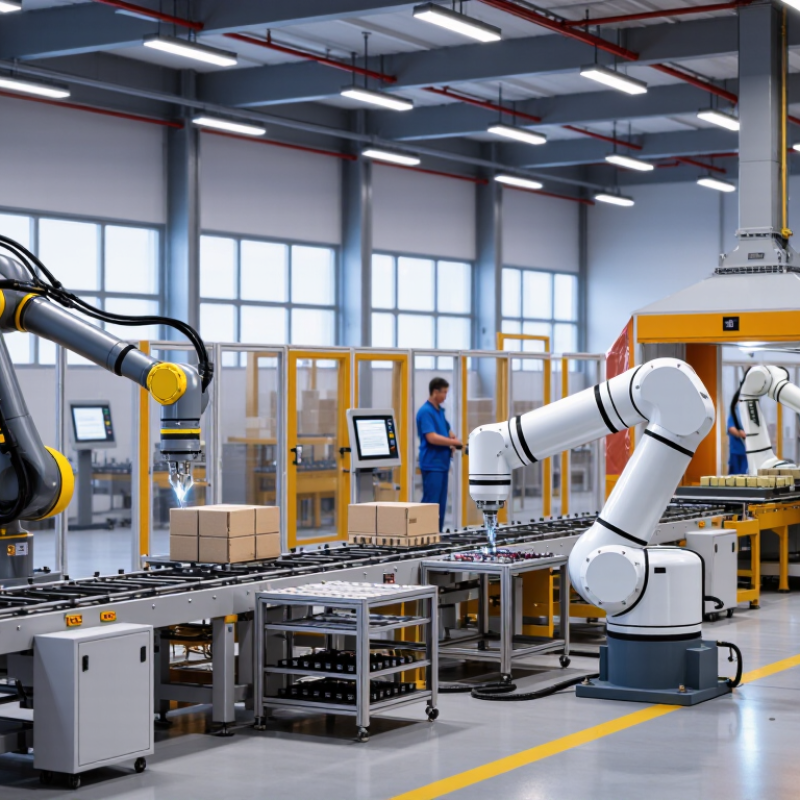
A welding cell needs repeatable positioning, heat resistance, and suitable reach. A packaging line may need speed, gentle handling, and easy tool changes. In practical factory assessments, cycle time often exposes weak choices faster than brochure specifications.
The market provides useful context. The International Federation of Robotics recorded
541,302 industrial robot installations in 2023. This figure shows strong global demand for automated production equipment. It does not mean every factory needs the same arm. Installations also differ by industry, region, payload, and application. Data can mislead.
A reliable selection process measures reach, payload, accuracy, operating speed, and safety requirements together. Engineers should also inspect floor space, cable routing, maintenance access, and worker interaction. A compact arm may reduce congestion, while a heavier model can support larger tools. Software compatibility matters too, especially when vision systems or conveyors are involved.
Do not ignore training.
Operators need clear controls and realistic troubleshooting procedures. Maintenance teams should estimate spare-part availability and service response before installation. Energy use deserves attention, although it is often overlooked during purchasing.
A pilot cell can reveal vibration, awkward loading, or unexpected delays that calculations miss. My own preference would be to test the complete workflow, because a technically impressive arm can still perform poorly when the surrounding process is unstable.
Classify Robot Arms by Axes, Payload, Reach, Speed, and Repeatability
What Is the Best Robot Arm for Industrial Automation?
Classify Robot Arms by Axes, Payload, Reach, Speed, and Repeatability
Choosing the best robot arm starts with the task, not the catalogue. A four-axis arm suits fast pick-and-place work on a flat plane. A six-axis arm handles angled parts, changing tool directions, and complex assembly paths. More axes add flexibility, but they also increase programming effort and maintenance points.
Payload must include the gripper, cables, and the heaviest product. A safety margin is essential, especially during sudden stops or fast acceleration. Reach describes the arm’s working envelope, not merely its maximum extension. Measure the envelope. Check fixture clearance, wrist angles, and access to the deepest station. In plant trials, a small reach error can force expensive layout changes.
Speed affects cycle time, but maximum joint speed rarely tells the whole story. Acceleration, path smoothness, and settling time often matter more. Repeatability shows how closely the arm returns to the same position. Accuracy is different; calibration and installation influence it. That distinction matters. My first selection mistake was prioritising speed over stable placement, which created vibration at the tool. Reality is messier. Review sample cycles with actual parts, not empty motion. Record payload, reach, cycle time, and repeatability under production conditions. Then compare the results against the process tolerance and operator access requirements.
Match SCARA, Six-Axis, Delta, or Cobot Arms to Specific Workcells
What Is the Best Robot Arm for Industrial Automation?
The best arm depends on the workcell, not the catalog specification. The International Federation of Robotics reported 541,302 industrial robots installed worldwide in 2023. That scale shows automation is mainstream, but selection remains application-specific.
Choose SCARA arms for flat-plane assembly, screwdriving, and small-part transfer. Their compact footprint suits a bench with feeders and vision sensors. Delta arms fit high-speed picking, especially when products arrive randomly on a conveyor. Watch the payload. A heavier gripper can quickly reduce acceleration and throughput.
Six-axis arms handle angled insertion, welding, machine tending, and complex tool paths. Their extra joints improve access, but they also increase programming and maintenance demands. Cobots suit lower-volume cells, frequent changeovers, and tasks beside trained operators. The IFR’s World Robotics 2024 report notes continued growth in collaborative automation, yet “collaborative” does not mean automatically risk-free.
Measure cycle time with the actual end effector installed. Test cable routing, reach limits, guarding, and restart behavior. A promising simulation can fail beside a warm conveyor.
One practical mistake is choosing payload first. In real cells, wrist torque, fixture access, and sensor latency often matter more. Industry guidance from the Association for Advancing Automation also stresses application-level risk assessment. The safest choice may be slower, simpler, and easier to service.
What Is the Best Robot Arm for Industrial Automation? — Match SCARA, Six-Axis, Delta, or Cobot Arms to Specific Workcells
| Robot Arm Type |
Typical Payload |
Typical Reach |
Typical Repeatability |
Typical Axes |
Relative Motion Speed |
Best-Matched Workcells |
Key Advantages |
Main Trade-Offs |
| SCARA |
2–20 kg |
400–1,000 mm |
±0.01–0.02 mm |
4 |
High planar pick-and-place speed; commonly up to approximately 60–120 picks per minute depending on payload and motion profile |
High-speed assembly, screwdriving, dispensing, packaging, insertion, and electronic component handling on a fixed horizontal plane |
Fast cycle times, high positional accuracy, compact footprint, and strong performance for vertical insertion tasks |
Limited flexibility for complex three-dimensional paths; usually requires dedicated guarding and a clearly defined work envelope |
| Six-Axis Articulated Arm |
3–300+ kg |
500–3,000+ mm |
±0.02–0.10 mm |
6 |
Medium to high, depending on arm size, payload, and application; optimized for reach and orientation rather than maximum pick rate |
Machine tending, arc welding, material handling, palletizing, painting, complex assembly, and multi-sided part processing |
Broadest range of motion, strong orientation control, large payload options, and suitability for irregular or three-dimensional workpieces |
Higher programming and integration complexity, larger safety envelope, and generally higher installation requirements |
| Delta |
0.5–15 kg |
200–1,500 mm working diameter |
±0.05–0.20 mm |
3–4 |
Very high; commonly suited to approximately 60–200+ picks per minute in optimized lightweight applications |
Food packaging, sorting, primary packaging, small-part picking, pharmaceutical handling, and vision-guided conveyor applications |
Excellent throughput, low moving mass, fast acceleration, and efficient overhead installation above conveyors |
Limited payload and orientation range; requires careful conveyor, vision, tooling, and product-flow coordination |
| Collaborative Robot Arm (Cobot) |
3–30 kg |
500–1,800 mm |
±0.02–0.10 mm |
6–7 |
Low to medium; often selected for flexible production rather than maximum cycle rate |
Low-volume assembly, machine tending, quality inspection, packaging, laboratory handling, and frequently changing production lines |
Flexible redeployment, relatively simple programming, compact integration, and potential for operation near people when a risk assessment confirms the application is safe |
Lower speed and payload than many conventional industrial robots; collaborative operation is not automatically safe and requires application-specific validation |
Indicative performance ranges vary by payload, arm geometry, tooling, cycle profile, environmental conditions, and safety configuration. Final selection should be validated against reach, cycle time, payload including tooling, repeatability, guarding requirements, and the applicable machinery-safety standards.
Verify Safety and Integration Against ISO 10218 and ISO/TS 15066
What Is the Best Robot Arm for Industrial Automation?
The best robot arm is not always the fastest or strongest model. It must fit the task, guarding, tooling, and production environment. Safety verification should begin with a documented risk assessment, not a sales specification. ISO 10218 addresses robot and system safety, including protective measures, controls, and integration. ISO/TS 15066 adds guidance for collaborative applications, including force and pressure limits for human contact. These limits are not a universal safety certificate. Each workstation still needs validation.
The International Federation of Robotics reported 542,000 industrial robot installations worldwide in 2023. Its World Robotics 2024 report also recorded about 4.28 million robots operating globally. More installations mean more mixed human-machine workplaces. A suitable arm should support reliable emergency stops, reduced-speed modes, monitored safety devices, and safe tool behavior. Integration testing must include the real gripper, workpiece, software logic, and operator access points. I have seen projects focus too heavily on the arm itself. That is a costly blind spot.
Tips: Ask the integrator for a clause-by-clause ISO 10218 review. Test collaborative functions under realistic loads, including sharp edges and unexpected motion. Confirm the latest applicable standard editions with a competent safety professional. Record stopping distances and protective-field responses. Do not assume low payload means low risk. Even a small arm can injure someone. A second review is worthwhile.
What Is the Best Robot Arm for Industrial Automation?
Verify Safety and Integration Against ISO 10218 and ISO/TS 15066
This qualitative coverage chart summarizes the primary focus of each safety standard. ISO 10218-1 addresses industrial robot design and manufacture, ISO 10218-2 addresses robot applications and cell integration, and ISO/TS 15066 provides additional guidance for collaborative robot applications. A value of 1 means the topic is directly within the standard’s primary scope; it is not a certification score or a substitute for a formal risk assessment.
Compare Total Cost, Uptime, and ROI Before Selecting the Best Arm
Choosing the best robot arm begins with a cost model, not a catalog photo.
Purchase price is only one line. Installation may require guarding, tooling, programming, training, and electrical changes. A lower-priced arm can become expensive when integration takes six extra weeks. Ask for a documented estimate based on your actual cycle, payload, reach, and shift pattern. Use measured data from the production cell whenever possible. Assumptions age quickly.
Uptime deserves equal weight. Review mean time between failures, service response, spare-part availability, and software support terms. A robot that loses two hours weekly can erase a tempting price advantage. Track stoppages by cause, not by total downtime alone. For example, repeated gripper faults may indicate poor tooling rather than an arm defect. Run a pilot with representative parts, heat, dust, and operator changes. Clean tests can mislead.
ROI should connect output to verified operating costs.
Calculate additional units, labor allocation, energy use, maintenance, consumables, and financing. Then compare the result with a realistic payback period. Do not treat every labor saving as cash saving. A reassigned operator may create value, while an eliminated position may not be immediate or practical. Include training time and planned maintenance in the model. Have production, maintenance, safety, and finance review the figures together. Their disagreement is useful. It exposes weak assumptions before capital is committed.