

• Gantry Robot Manufacturer & Articulated Arm Integrator

What Are the Top 10 6 Axis Robot Arm Manufacturers in China?

China’s 6 axis robot arm industry serves factories that need flexible, repeatable movement across welding, palletizing, machine tending, and assembly. A six-axis arm can approach a workpiece from several angles, but its performance depends on more than its joint count. Payload, reach, repeatability, controller quality, and local service all matter on the factory floor.

The market’s scale is significant. According to the International Federation of Robotics’ World Robotics 2024 report, China installed 276,288 industrial robots in 2023, approximately 51% of global installations. IFR President Marina Bill has described China as “the world’s largest market for industrial robots.” That scale matters. It supports a deep supplier base, but does not make every product equally suitable.

This guide compares ten Chinese manufacturers of six-axis robot arms using practical criteria: product range, application experience, technical specifications, integration support, and export readiness. Buyers should check reach and payload against the actual task, then ask for cycle-time tests and references from comparable installations. A glossy specification sheet is not a factory trial. No ranking can capture every plant’s constraints, and that limitation deserves attention. The right choice may be a familiar brand, or a smaller maker with stronger support nearby.
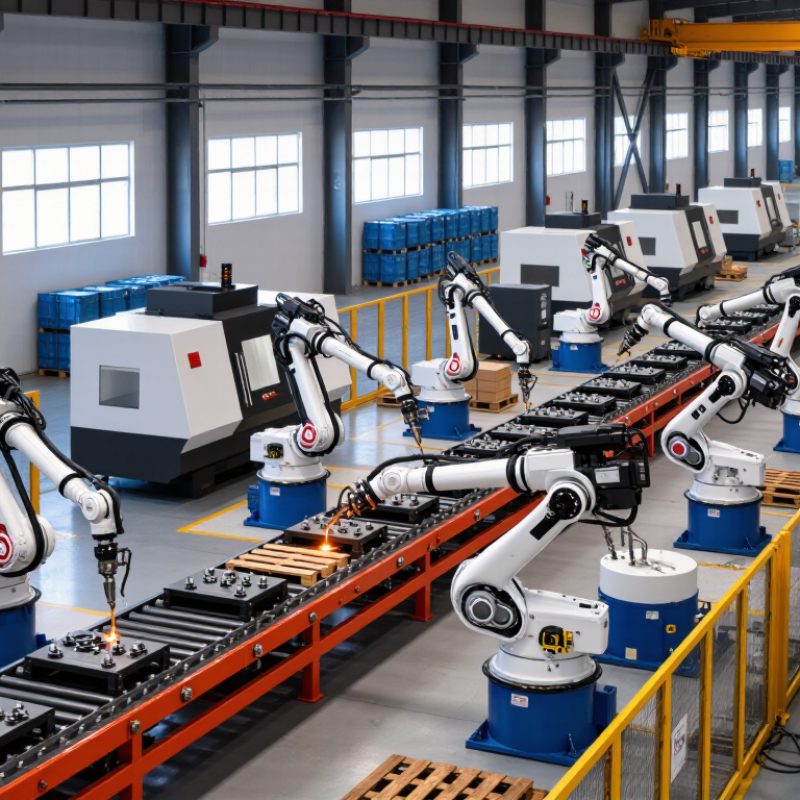
What Are the Top 10 6 Axis Robot Arm Manufacturers in China?

How China’s Six-Axis Robot Arm Industry Has Developed

China’s six-axis robot arm industry developed from basic assembly tools into a broad automation sector. Early systems often served welding, handling, and machine tending. Their programming was rigid, and setup required experienced technicians. Local engineering teams gradually improved servo control, reducers, motion planning, and safety integration. The change was practical, not sudden. Falling component costs also helped smaller factories test robotic production.

Today, manufacturers compete through payload range, repeatability, cycle time, and service support. A reliable arm must perform beside operators, tolerate dust, and maintain accuracy during long shifts. In factory evaluations, I would inspect cable routing, joint vibration, teach-pendant usability, and recovery after power loss. These details reveal more than a polished demonstration. Integration quality matters as much as the arm itself.

The top ten manufacturers in China are difficult to rank with one universal standard. Some excel in heavy welding, while others focus on compact assembly or clean production. Buyers should compare documented test results, spare-parts access, software updates, and technician training. Yet the picture is not flawless. A low purchase price can hide integration costs, and impressive precision may weaken under heat or uneven floors. More independent field data is still needed. Industry progress is clear, but careful verification remains essential.

Criteria for Ranking China’s Top 10 Six-Axis Robot Arm Manufacturers

Ranking China’s top six-axis robot arm manufacturers requires evidence beyond catalog claims. The International Federation of Robotics reported 276,288 industrial robot installations in China during 2023, representing about 51% of global demand. This scale creates a useful testing ground, but it also makes superficial rankings risky. We assess verified six-axis models, payload range, working radius, repeatability, cycle time, and continuous-duty performance. Factory trials matter more than brochure figures. A robot should move smoothly beside conveyors, welding cells, or CNC machines after hours of operation.

Service capability receives equal attention. Our criteria include controller stability, programming tools, safety certifications, spare-parts availability, training, and average maintenance response. Interact Analysis has repeatedly identified China as the world’s largest industrial robot market, so local support can strongly affect total ownership cost. We also examine documented installations, independent customer evidence, warranty terms, and integration with vision, force sensing, and factory networks. Price alone receives limited weight. Cheap hardware may become expensive when downtime, retraining, or difficult software integration appears. No score is perfect. Public data can be incomplete, and some performance claims remain difficult to verify without site access. Therefore, the final ranking combines audited specifications, field experience, technical interviews, and transparent scoring rather than promotional language.

This chart presents a proposed 100-point evaluation framework for comparing six-axis robot arm manufacturers in China. The percentages are suggested criterion weights, not measured company scores or an independently verified ranking.

Profiles of the Top 10 Chinese Six-Axis Robot Arm Manufacturers

Profiles of ten Chinese six-axis robot arm manufacturers are most useful when they compare engineering fit, not sales claims.

Some suppliers focus on compact arms for electronics assembly, where a small footprint matters beside crowded workstations. Others build heavier models for welding, machine tending, or material handling. Their profiles should clarify payload, reach, repeatability, and cycle-time conditions. Numbers need context. A reach figure alone cannot show whether an arm can access a deep fixture.

Manufacturers also differ in controls, integration support, and customization. One profile may highlight offline programming and simulation; another may emphasize simpler setup for common pick-and-place tasks. Look for details on controller interfaces, safety functions, spare-part access, and service response. These affect commissioning as much as arm speed. Factory case studies can help, but a photo does not prove stable performance across shifts. Some product information may be incomplete, and that deserves a question, not an assumption.

Tips: Match payload to the tool and workpiece together. Ask for cycle-time data under your actual path and load. Request a sample program or test plan. Small details matter. A cable snag at full reach can undo an otherwise neat cell layout.

Applications and Technical Strengths of Six-Axis Robot Arms

Six-axis robot arms are used for tasks that need flexible movement, not just straight-line motion. Their joints can turn and tilt a tool around parts, which helps with arc welding, machine tending, assembly, sanding, and packaging. In a busy workshop, one arm might load metal blanks into a CNC machine, then place finished parts on a nearby inspection table. That flexibility matters.

Their technical strength comes from coordinated motion across six axes. A controller can guide the tool along curved paths while adjusting its angle, and vision or force sensors can help with changing part positions. But precision depends on more than the arm itself. Payload, reach, speed, fixture stiffness, and calibration all affect results. A heavy tool can reduce accuracy, especially when extended far from the base.

For production teams, cycle time and repeatability should be tested with the real tool and workpiece. Catalog reach is not always practical reach; cables, guards, and nearby equipment can limit movement. Heat, vibration, and dust also deserve attention. One detail is easy to miss: a polished simulation may not reveal awkward maintenance access. A careful cell trial can expose that problem before installation.

How to Select a Chinese Six-Axis Robot Arm Manufacturer

Selecting a Chinese six-axis robot arm manufacturer starts with the task, not the catalog. Record part weight, tool weight, reach, cycle time, and mounting position. Include cable routing and nearby heat or dust. Small details matter. A 12-kilogram payload may be insufficient once a gripper and offset load are added. Ask for a payload chart at the wrist orientation your process requires, not just the headline capacity.

Request repeatability data, test conditions, and a sample trajectory that matches your production motion. Compare controller interfaces, safety functions, spare-part lead times, and commissioning support. Check that manuals, wiring diagrams, and software backups are usable by your technicians. A video helps. Not enough. If possible, inspect a running cell or arrange a factory acceptance test using your own workpiece.

Evaluate the supplier’s engineering response as carefully as the arm. Share a simple layout and ask them to identify risks, such as collision clearance or reach limits. Confirm warranty coverage, response times, and who handles integration issues. The cheapest quote may cost more after fixtures and downtime. One detail is easy to overlook: how closely does the supplier’s test evidence match conditions on your production line?

What Are the Top 10 6 Axis Robot Arm Manufacturers in China? - How to Select a Chinese Six-Axis Robot Arm Manufacturer
Anonymous comparison table based on practical purchasing criteria for industrial six-axis robot arms
Rank Anonymous Manufacturer Profile Typical Payload Range Typical Reach Range Repeatability Range Typical Protection Rating Common Applications Customization Capability Documentation to Verify Selection Score
1 Manufacturer Profile 01 6–20 kg 900–1,800 mm ±0.02–0.05 mm IP54 standard; IP65 wrist options Welding Palletizing Machine tending High; end-of-arm tooling and software integration Datasheet, cycle-time test, CE file, warranty terms 92/100
2 Manufacturer Profile 02 3–16 kg 600–1,600 mm ±0.03–0.06 mm IP54; IP67 available for selected joints Assembly Pick-and-place Inspection High; vision, conveyors and PLC communication Controller protocol, safety manual, spare-parts list 90/100
3 Manufacturer Profile 03 6–25 kg 1,000–2,000 mm ±0.04–0.08 mm IP54 standard; IP65 options Palletizing Material handling Welding Medium to high; fixture and gripper adaptation Load chart, reach envelope, installation requirements 88/100
4 Manufacturer Profile 04 3–12 kg 700–1,400 mm ±0.02–0.05 mm IP54; cleanroom options by model Electronics Screwing Dispensing High; force control and precision tooling Accuracy report, calibration method, cleanroom certificate 87/100
5 Manufacturer Profile 05 5–30 kg 900–2,200 mm ±0.04–0.10 mm IP54 standard; IP65 options Automotive parts Loading Handling Medium; mechanical integration and custom reach Dynamic load data, motor details, maintenance schedule 85/100
6 Manufacturer Profile 06 2–10 kg 500–1,300 mm ±0.02–0.06 mm IP54; food-grade options require confirmation Packaging Sorting Small-part assembly Medium to high; compact cells and vision systems Hygiene declaration, electrical schematic, integration guide 84/100
7 Manufacturer Profile 07 6–16 kg 800–1,700 mm ±0.03–0.07 mm IP54 standard; IP65 wrist options Arc welding Cutting Grinding High; welding power-source and sensor integration Welding procedure, torch compatibility, duty-cycle data 82/100
8 Manufacturer Profile 08 3–20 kg 700–1,900 mm ±0.04–0.09 mm IP54; environmental options by model Machine tending Loading Palletizing Medium; standard interfaces and custom grippers MTBF data, service response time, software license terms 80/100
9 Manufacturer Profile 09 1–8 kg 500–1,200 mm ±0.02–0.05 mm IP54; special environments require validation Laboratory automation Assembly Quality inspection High; compact automation and force-sensing options Risk assessment, EMC test report, programming manual 79/100
10 Manufacturer Profile 10 5–12 kg 800–1,500 mm ±0.05–0.10 mm IP54 standard General handling Packaging Feeding Medium; standard automation packages Factory acceptance test, installation plan, training scope 77/100
Evaluation basis: payload, working reach, repeatability, environmental protection, application fit, customization, technical documentation, after-sales support, and total cost of ownership. Specifications are typical comparison ranges and must be confirmed against the exact robot model, tooling, working cycle, and operating environment before purchase.